 Velvi
Short answer
Psoriasis on the face is common. The National Psoriasis Foundation (NPF) says about half of people with psoriasis have it there. It shows as raised, scaly, red or darker patches that may itch or hurt, often near the hairline, and it can affect the eyelids. It isn't contagious, and it's worth seeing a doctor, because facial skin is delicate and needs care in choosing treatment.
A rash on your face is hard to hide, and it can be upsetting. This guide explains where psoriasis appears on the face, what it looks like, why the skin around the eyes needs extra care, and what to ask your doctor.
Where psoriasis shows up on the face
The NPF describes two patterns. Patches near the scalp or ears are more common. Patches on the eyelids and around the eyes are less common.
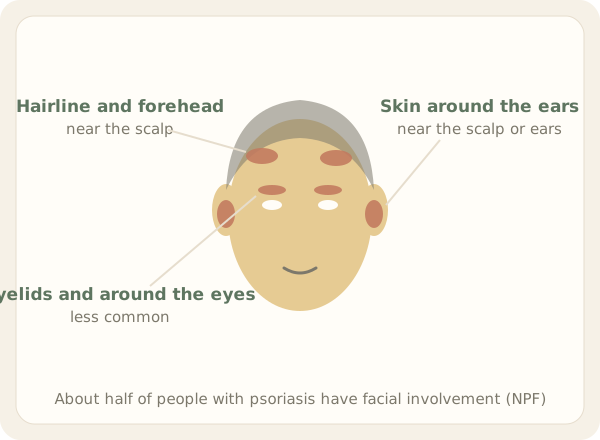
The NPF also says scalp psoriasis can reach beyond the scalp itself, to the hairline, the forehead, the back of the neck and the skin around the ears. If you have scalp patches, the face edge is a good place to look. See Scalp psoriasis.
Facial psoriasis is more likely if you have had psoriasis for a long time, if it runs in your family, or if your psoriasis is severe, the NPF says. The patches around the eyes are linked with more psoriasis elsewhere on the body.
It can happen with any skin tone.
What it looks like
The NPF describes plaques: raised, inflamed, scaly patches that may itch or hurt. For more, see Plaque psoriasis.
- On lighter skin, plaques are usually red with silvery-white scale.
- On skin of color, they may look darker, thicker, purple, gray or darker brown.
The NHS adds that after psoriasis clears on brown or black skin, it can leave dark marks.
Around the eyes, the NPF lists redness or discoloration, dry eye, discomfort and, possibly, problems with vision. Tell your doctor about any eye symptoms. They can tell you whether you need a referral.
How it can affect you
The NPF says the face is a high-impact site: visible patches can affect quality of life and bring shame, embarrassment or low mood. It notes that thoughts of suicide can happen too, and help is available.
This is a real part of psoriasis, not vanity. Tell your doctor how the patches affect you, not only how they look. If you feel very low, talk to a doctor or a mental health professional. If you are thinking about harming yourself, contact your local emergency number or crisis line.
Is it psoriasis?
Other rashes, including seborrheic dermatitis and eczema, can also appear on the face, and you can't reliably tell them apart yourself. The NPF says doctors diagnose psoriasis mainly from how the skin looks, where the patches are and how itchy they are. A skin sample (biopsy) is not usually needed. A doctor may take one if the diagnosis is unclear or to rule out other skin conditions, and NIAMS says the same.
For one common look-alike, see Psoriasis vs eczema. Only a doctor can tell which one you have.
Treatment: why the face needs care
The NHS says psoriasis can't be cured, but treatments can help manage symptoms. NIAMS says the choice depends on the type, the severity and where on the body it is.
The NPF groups treatments for facial psoriasis into:
- topical treatments: creams and ointments put on the skin
- phototherapy: controlled treatment with ultraviolet light
- systemic treatments: tablets or injections that work throughout the body
The skin on the face, and especially on the eyelids, is very sensitive. The NPF says treatment there needs care. Overusing some topical treatments around the eyes can cause irritation and may raise the risk of cataracts and glaucoma, which is why a doctor should guide this. The NPF also says topical steroids should not be used on facial psoriasis.
So don't use a cream you already have, or one meant for another body area, on your face unless a doctor has said it is safe. A GP can prescribe some treatments or refer you to a dermatologist, the NHS says. Follow your provider's instructions for anything you use. Talk to your doctor before starting, stopping or changing any treatment.
Everyday skin care
NIAMS lists general steps that can help: bathe in lukewarm water, use mild soap and apply a heavy moisturizer while the skin is still damp. Your doctor may also suggest a cleanser or moisturizer.
NIAMS says some people find that stress, cold weather, skin injury, certain medicines and infections can spark flares. The NPF adds tobacco, alcohol and changes in weather, and says there's no known way to prevent psoriasis, but managing triggers can reduce flares. Don't stop any medicine because you suspect it. Ask your doctor first.
How to track facial psoriasis in a diary
A diary shows your doctor what the patches do over weeks, which is hard to explain from memory. You might note:
- where: hairline, forehead, eyelids, near the ears, one side or both
- how it looks: red or darker, scaly, cracked, dry
- itch and pain, each from 0 to 10
- eye symptoms: dryness, discomfort, redness, changes in vision
- possible triggers: stress, illness, weather, a new medicine, a skin injury
- what you used on your face, as your doctor advised
- how it affected your day: sleep, work, going out, mood
- a photo once a week in the same light, kept private
Example entry: Thursday. Red, scaly patch along the left hairline, itch 4/10. Both eyelids a bit dry, no pain. Stressful week at work. Used only the moisturizer my doctor suggested. Felt self-conscious in a meeting.
An app such as Velvi can keep these notes and photos in one private place, ready for your appointment.
Questions to ask your doctor
- Is this psoriasis, or could it be another rash?
- Which treatments are safe for my face, and which for my eyelids?
- What should I avoid putting on my face?
- Do I need to see an eye specialist?
- Do I have psoriasis elsewhere, including my scalp?
- What can I do about daily skin care, such as washing and moisturizing?
- How should I keep track of changes, and when should I come back?
When to see a doctor
See a GP (family doctor) or dermatologist if you have a scaly, red or itchy rash on your face that doesn't settle, if a treatment isn't working or causes side effects, or if the patches are affecting your mood. Tell your doctor about eye symptoms such as dryness, discomfort or changes in vision.
See a doctor promptly if you have joint pain, stiffness or swelling that keeps coming back — it could be psoriatic arthritis.
Seek medical care now if you have widespread red skin, pus-filled bumps with a fever, or feel very unwell — contact your doctor or your local emergency number.
Frequently asked questions
Can you get psoriasis on your face?
Yes. The NPF says about half of people with psoriasis have facial involvement.
Is psoriasis on the face contagious?
No. Psoriasis can't be passed from person to person. See Is psoriasis contagious?
Can psoriasis affect the eyelids?
Yes, though it is less common than patches near the scalp or ears, the NPF says. The skin is very sensitive, so see a doctor before using any treatment there.
Can I use any cream on my face?
Ask your doctor or pharmacist first. The NPF says overusing some topicals around the eyes can cause irritation and may raise the risk of cataracts and glaucoma.
Does psoriasis on the face go away?
The NPF says treatment can improve symptoms, and the NHS says psoriasis can't be cured. Symptoms can clear and come back, so many people use a diary to spot patterns.
Is facial psoriasis a sign of something serious?
Facial psoriasis is common. The NPF says it is more likely in severe or long-standing psoriasis, and that patches around the eyes go with more psoriasis elsewhere on the body. Tell your doctor to your doctor so they can look at the whole picture.
Sources
- Psoriasis on the eyelids — National Psoriasis Foundation
- Scalp psoriasis — National Psoriasis Foundation
- Psoriasis — National Institute of Arthritis and Musculoskeletal and Skin Diseases (NIAMS)
- Psoriasis: diagnosis, treatment and steps to take — National Institute of Arthritis and Musculoskeletal and Skin Diseases (NIAMS)
- Psoriasis: symptoms — NHS
- Psoriasis: treatment — NHS
- Psoriasis — NHS
We check articles against these sources and update them when guidance changes. Read our editorial policy.