 Velvi
Short answer
Plaque psoriasis is the most common type of psoriasis. It causes raised, scaly patches of skin called plaques — on white skin usually red with silvery-white scale, on darker skin they may look purple, grey or dark brown. Plaques most often appear on the scalp, elbows, knees, torso and lower back, and they can itch or hurt. It isn't contagious, and while there is no cure, treatments can help manage it.
Most people with psoriasis have this type. Both the National Psoriasis Foundation (NPF) and the American Academy of Dermatology (AAD) put it at about 80 to 90 out of every 100 people with psoriasis. This guide explains what plaques look like, where they tend to appear, what can make them worse, and what to ask your doctor.
Other types look different. MedlinePlus describes guttate psoriasis as small pink-red spots, inverse psoriasis as redness in skin folds such as the armpits and groin, and pustular psoriasis as pus-filled blisters. Read more in Psoriasis symptoms.
What plaque psoriasis looks like
A plaque is a patch of skin that is thicker and raised above the skin around it. The NPF describes plaques as raised, inflamed (red and swollen) and scaly. The scale is a build-up of dead skin cells. The AAD describes it as a dry, thin, silvery-white coating on top of some plaques.
Colour depends on your skin tone:
- On white skin, plaques are usually red or pink with silvery-white scale.
- On brown or black skin, the NPF says plaques may look darker and thicker, and more purple, greyish or dark brown. The NHS says patches can look grey and may leave dark marks after they clear.
MedlinePlus describes the patches as well-defined, meaning they have a clear edge. The NHS says patches are often about 1 to 2 cm across, oval or irregular. Most people have only a few patches. Others have large areas, or many small ones. The AAD adds that small plaques can join together into bigger ones.
How plaques can feel:
- itchy — the AAD says itch is common
- sore, painful or burning — the NHS, the NPF and NIAMS all mention this
- dry and cracked — NIAMS (part of the US National Institutes of Health) says cracked skin can itch or bleed
NIAMS also lists poor sleep as a symptom.
Where plaques usually appear
Plaques can appear anywhere on the skin. The NPF says they most often appear on:
- the scalp
- elbows
- knees
- the torso (chest, tummy and back)
The AAD also names the lower back as a common place.
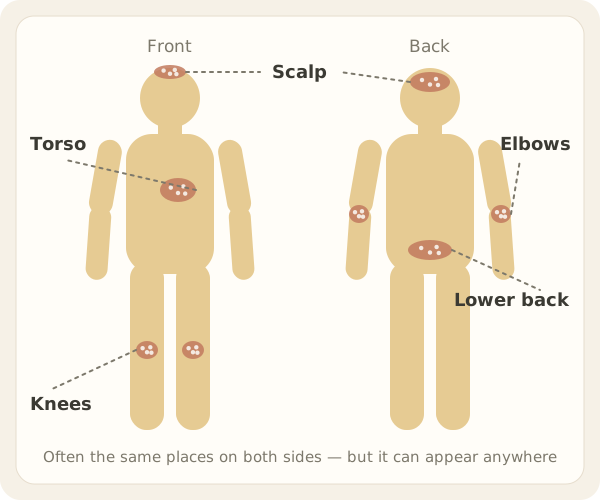
Plaques often show up in the same places on both sides of the body — both elbows or both knees, for example. The NPF and NIAMS both describe this mirror pattern.
Some places matter more than their size suggests. The NPF calls the scalp, nails, hands, feet, genitals and skin folds "high-impact" areas. Even a small patch there can affect daily life. Read more in our guide to scalp psoriasis.
Nails and joints
Plaque psoriasis isn't only about skin. The AAD says about half of people with plaque psoriasis notice changes in their fingernails at some point. These can include:
- small dents (pits) in the nail
- white, yellow or brown discoloration
- crumbling or rough nails
- a nail lifting away from the skin under it
- a build-up of skin under the nail
Psoriatic arthritis is a type of arthritis linked to psoriasis. It causes painful, stiff or swollen joints. The NPF says about 1 in 3 people with psoriasis may develop it. Tell your doctor about any joint pain, stiffness or swelling, even if your skin is calm.
Mild, moderate or severe?
Doctors often describe psoriasis as mild, moderate or severe. The NPF explains that this label is based on how much of your body's skin is affected. It doesn't account for hard-to-live-with places like the scalp, hands or genitals, or for how much it affects your life.
So a "mild" label doesn't mean your psoriasis is easy to live with. A small patch on your palm can get in the way more than a larger one on your back. If a small patch on your hands or face is getting in the way of work, sleep or confidence, say so. It's a fair thing to raise with your doctor.
What causes plaques, and what makes them worse
Plaque psoriasis starts in the immune system. The NPF says an overactive immune system speeds up how fast skin cells grow. Normally, skin cells take about a month to grow and shed. In psoriasis, this happens in three or four days. The cells pile up on the surface and form plaques. The exact cause isn't fully understood. Read more in What causes psoriasis?
Psoriasis isn't contagious — see Is psoriasis contagious?. The NHS says you are more likely to develop it if someone in your family has it.
Plaque psoriasis is lifelong, but it tends to come and go. Flare-ups, when it gets worse, alternate with calmer periods. The NPF and the NHS list things that can set off a flare, including:
- stress
- infections
- skin injuries, such as cuts, scratches or grazes
- some medicines, and starting or stopping a medicine
- smoking and alcohol
The NPF says managing your own triggers can help reduce flares. Don't stop or change a medicine because you think it's a trigger — talk to your doctor first.
About scratching: the AAD says scratching can make plaques thicker. Dermatologists recommend treating the psoriasis to calm the itch rather than scratching.
How plaque psoriasis is diagnosed and treated
A doctor can usually diagnose plaque psoriasis by looking at your skin, says MedlinePlus. Sometimes they take a small skin sample (a biopsy) to rule out other conditions. Other skin conditions can look similar, so only a doctor can tell what you have.
There is no cure, but the NPF says there are more effective treatments now than ever before. The main groups it lists are:
- topicals — creams, ointments and other treatments put on the skin, some available without a prescription
- phototherapy — treatment with ultraviolet light
- systemic treatments — medicines that work throughout the body, taken as tablets or injections; this group includes biologics, which target specific parts of the immune system
NIAMS says milder psoriasis is often treated with creams or ointments. Moderate to severe psoriasis may need pills, injections or light treatment. The NHS adds that treatment depends on the type of psoriasis, how severe it is and where it is, and that combinations are common. Your GP (family doctor) can prescribe some treatments or refer you to a dermatologist, a doctor who specialises in skin.
If a treatment isn't helping or causes side effects, tell your doctor. Talk to them before changing or stopping anything.
Everyday skin care can sit alongside treatment. MedlinePlus suggests washing gently without scrubbing hard, keeping your skin clean and moist, avoiding known triggers and avoiding sunburn.
How to track plaque psoriasis in a diary
Plaques change slowly, so it's hard to remember how they looked a month ago. A short diary gives you and your doctor something to compare. You might note:
- where each plaque is, and whether new ones have appeared
- size: smaller, the same or bigger than last time
- itch and pain, each on a scale of 0 to 10
- sleep: did itch wake you?
- cracking or bleeding
- nails and joints: any new changes or stiffness
- possible triggers: stress, illness, a cut, alcohol, a new medicine
- what you used, as your doctor advised
- a photo of the same plaque every week or two, in the same light and from the same distance
Example entry: Sunday. Both elbows, the left one about the size of a coin. A new small patch on my right knee. Itch 6/10, woke me once. Skin cracked at the left elbow. Had a cold last week. Busy, stressful days at work.
Bring your notes and photos to your appointment. An app such as Velvi can keep them in one place.
Questions to ask your dermatologist
- Is this plaque psoriasis, or could it be something else?
- How severe is my psoriasis, and do the places it affects change that?
- Which type of treatment suits my skin and the places I have plaques?
- How long should I try a treatment before we review it?
- What should I do about the itch?
- Are my nail changes linked to psoriasis?
- Should I be checked for psoriatic arthritis?
- Are there triggers I should watch for?
When to see a doctor
See a GP (family doctor) or dermatologist if you think you might have psoriasis, or if plaques are affecting your sleep, work or confidence. Go back if your treatment isn't helping or causes side effects.
See a doctor promptly if you have joint pain, stiffness or swelling — it could be psoriatic arthritis.
Seek medical care now if you have widespread red skin, pus-filled bumps with a fever, or feel very unwell — contact your doctor or your local emergency number.
Frequently asked questions
Is plaque psoriasis contagious?
No. You can't catch plaque psoriasis from someone or pass it on to anyone else.
Does plaque psoriasis go away?
It often comes and goes, with flare-ups and calmer periods that can last a long time. It is lifelong and there is no cure, but treatment can usually keep it under control.
Can plaque psoriasis spread?
It can't spread to other people. On your own body, new plaques can appear in new places and small plaques can join together. Tell your doctor if it's spreading.
Does plaque psoriasis affect the rest of the body?
It can. NIAMS says psoriasis raises the risk of other conditions, including psoriatic arthritis, heart attacks and strokes, anxiety and depression. A higher risk doesn't mean you will get them. The NPF says treatment may help lower the risk of some related conditions, such as psoriatic arthritis and heart disease. Ask your doctor what checks make sense for you.
Can plaque psoriasis appear on the face?
Yes. Plaques can appear anywhere on the skin, including the face, although the scalp, elbows, knees and torso are more common places. See a doctor about any new patch on your face. We cover this in Psoriasis on the face.
Sources
- Plaque psoriasis — National Psoriasis Foundation
- Psoriasis: Signs and symptoms — American Academy of Dermatology
- Psoriasis — NHS
- Psoriasis — MedlinePlus (U.S. National Library of Medicine)
- Psoriasis — National Institute of Arthritis and Musculoskeletal and Skin Diseases (NIAMS)
We check articles against these sources and update them when guidance changes. Read our editorial policy.