 Velvi
Short answer
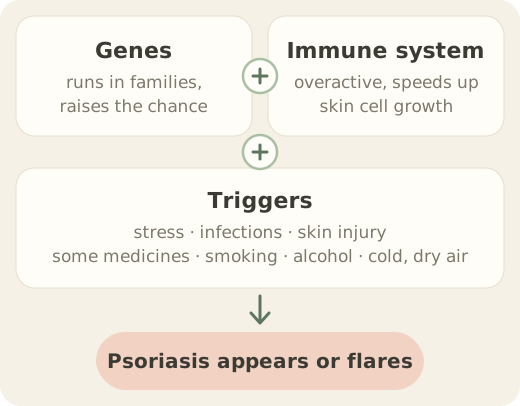
Psoriasis is caused by a problem with the immune system that makes skin cells grow far too fast. Genes play a big part — it often runs in families — and triggers such as stress, infections, skin injuries, some medicines, smoking and alcohol can set it off or make it flare. Scientists still don't fully understand what starts the process.
There isn't one single cause of psoriasis. It comes from a mix of things inside the body (your immune system and your genes) and things around you (triggers). This article walks through each part, what's known and what isn't, and how to spot your own triggers.
The immune system: where it starts
Your immune system protects you from germs. In psoriasis, part of it becomes overactive.
The American Academy of Dermatology (AAD) explains that immune cells called T-cells, which usually fight bacteria and viruses, also start acting against the skin. NIAMS describes how these immune cells release signals that make the skin produce new cells much faster than normal.
The National Psoriasis Foundation says healthy skin takes about a month to grow and shed. In psoriasis, it takes three or four days. The old cells can't shed quickly enough, so they pile up into the raised, scaly patches you can see.
This is why doctors call psoriasis immune-mediated. The skin shows the signs, but the immune system drives them. It's also why psoriasis is not contagious — there's no germ involved. (More on that in Is psoriasis contagious?)
Genes: why it runs in families
Psoriasis often runs in families. According to the AAD, your risk is higher if a parent, grandparent, brother or sister has it. NIAMS notes that researchers have found a number of genes linked to psoriasis, and many of them are involved in how the immune system works.
But genes aren't destiny. The AAD points out that:
- some people with psoriasis don't carry the known risk genes, and
- some people who carry them never develop psoriasis.
In other words, genes can make psoriasis more likely, but something else usually needs to happen too.
Triggers: what can set it off
A trigger is something that can make psoriasis appear for the first time, or cause a flare in someone who already has it. The AAD, NIAMS and the NHS list these common triggers:
- Stress. NIAMS notes that stress can set off flares.
- Skin injury. A cut, scrape or bad sunburn can be followed by a new patch in that spot.
- Infections. Strep throat is a well-known example, especially for guttate psoriasis in children and young adults. NIAMS and the NHS also mention HIV.
- Some medicines. The AAD names lithium, prednisone and hydroxychloroquine. NIAMS also mentions some medicines for heart disease, malaria and mental health conditions.
- Smoking.
- Alcohol, especially heavy drinking.
- Cold, dry weather.
- Obesity, listed by NIAMS and the NHS.
The NHS also notes that pregnancy can change psoriasis, and that some treatments may need to change during pregnancy — that's a conversation to have with your doctor or pharmacist.
Important: if you think a medicine might be affecting your skin, don't stop taking it on your own. Talk to the doctor who prescribed it — they can look at the whole picture with you.
Triggers are personal
Not everyone reacts to the same things. The AAD stresses that triggers vary from person to person, and that learning your own triggers can help you have fewer flare-ups.
Some triggers you can't avoid, like the weather or a virus going around. Others you may be able to plan for. Either way, knowing what tends to come before a flare can help you and your doctor make a plan.
How to spot your own triggers
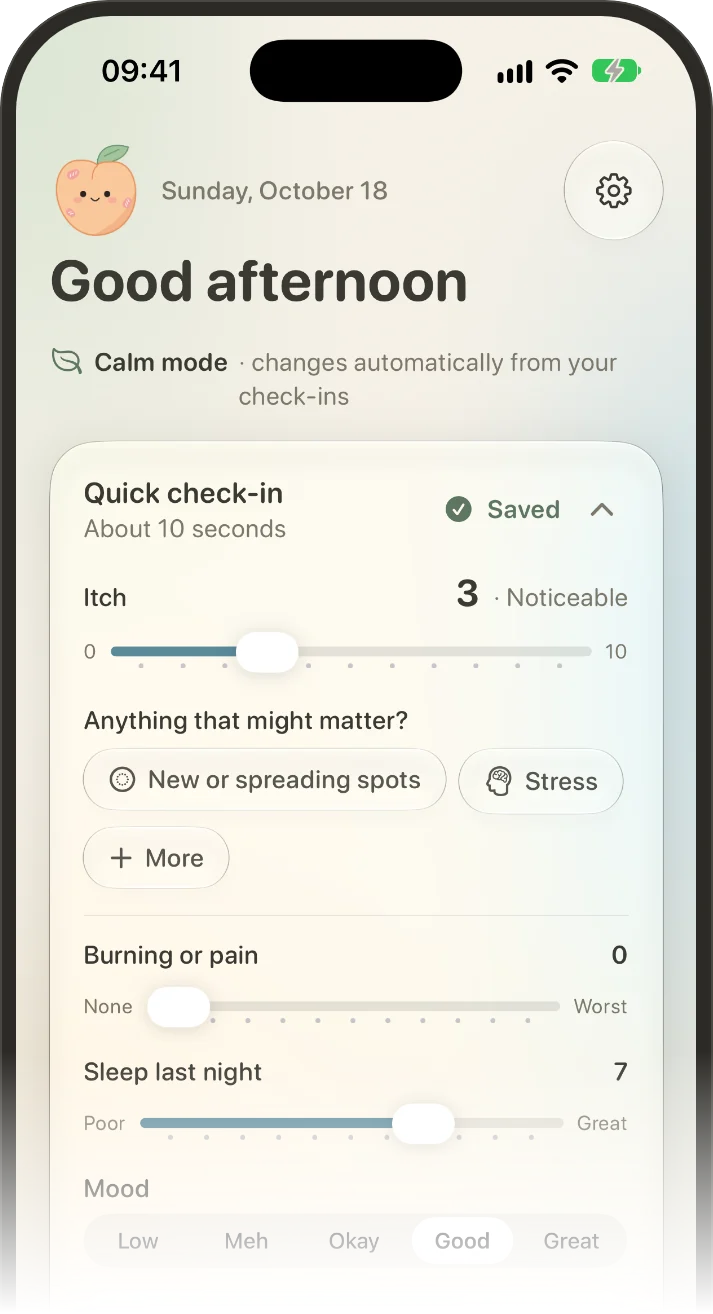
Flares often build over days, so it can be hard to connect cause and effect from memory. A simple diary helps. Each day, or whenever something changes, you could note:
- How your skin is — itch and soreness on a 0–10 scale, and which areas are affected.
- Stress — a quick rating, plus anything big that happened.
- Sleep — how long and how well.
- Illness — sore throat, cold, fever.
- Skin injuries — cuts, scrapes, sunburn.
- Weather — cold snaps, very dry air.
- Alcohol and smoking — roughly how much.
- Medicines — any new medicine, or a change in dose made by your doctor.
Example entries:
- Mon — Sore throat started. Skin fine, itch 2/10.
- Fri — Lots of small new spots on my chest and back. Itch 5/10.
- Sun — Spots still spreading. Booked a GP appointment.
Notes like these don't prove what caused a flare, but they give your doctor useful clues. Bring them, along with a few photos, to your next appointment. Our guide to psoriasis flare-up triggers goes into more detail.
What isn't known yet
It's fair to say the science isn't finished. The NHS says the exact cause of psoriasis isn't fully understood, and NIAMS notes that scientists don't yet know exactly what sets off the faulty immune activity. Research into genes and the immune system is ongoing.
What is clear: psoriasis isn't contagious, it isn't anyone's fault, and it can be managed with the right care.
Questions to ask your doctor
- Could any of my current medicines be affecting my psoriasis? (Ask before changing anything.)
- Are there triggers you'd suggest I watch for, given my type of psoriasis?
- Should my family members know about any risk?
- If I get a sore throat or infection, should I contact you?
- What's the plan if I have a flare?
When to see a doctor
See your doctor if you think you might have psoriasis, if a flare isn't settling, or if your treatment isn't working or causes side effects. If you have joint pain, stiffness or swelling that keeps coming back, mention it — psoriasis can be linked to psoriatic arthritis, which is best checked early.
Seek medical care now if you have widespread red skin, pus-filled bumps with a fever, or feel very unwell — contact your doctor or your local emergency number.
Frequently asked questions
Can stress alone cause psoriasis?
Stress is a common trigger, but it's not thought to be the whole cause. Psoriasis involves the immune system and genes too. Stress can, however, make psoriasis appear or flare in people who are prone to it.
Can you get psoriasis if no one in your family has it?
Yes. Family history raises the risk, but some people with psoriasis have no relatives with it.
Does diet cause psoriasis?
Food isn't listed as a cause by the sources we use. The NHS does suggest a balanced diet and regular exercise as part of looking after yourself. If you're thinking about changing your diet, talk to your doctor or a dietitian.
Can psoriasis start at any age?
It can, but the NHS says it most often starts between 15 and 25, or between 50 and 60.
Sources
- Psoriasis: Causes — American Academy of Dermatology
- Psoriasis — National Institute of Arthritis and Musculoskeletal and Skin Diseases (NIAMS)
- Psoriasis — NHS
- About psoriasis — National Psoriasis Foundation
We check articles against these sources and update them when guidance changes. Read our editorial policy.