 Velvi
Short answer
Psoriasis is a long-term skin condition. The immune system becomes overactive and makes skin cells grow much faster than usual, so they build up into dry, scaly, often itchy patches. It isn't contagious, it tends to come and go in flare-ups, and while there is no cure, treatments can help manage it.
If you or someone close to you has just heard the word "psoriasis", it can feel like a lot to take in. This guide explains what it is, what it usually looks like, why it happens, and what you can do next — in plain words.
What happens in the skin
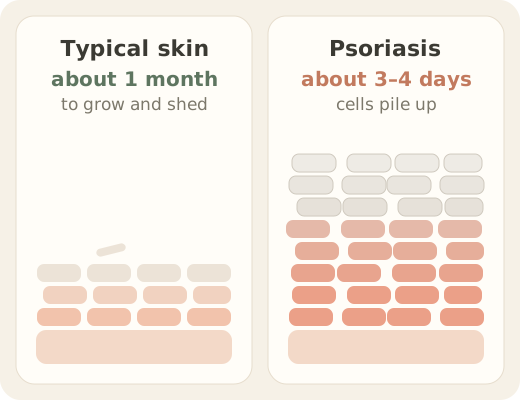
Normally, your skin slowly makes new cells and sheds old ones. The National Psoriasis Foundation says this cycle takes about a month. In psoriasis, it speeds up to just three or four days. The skin can't shed cells that fast, so they pile up on the surface and form raised, scaly patches.
The reason for this speed-up is the immune system. In psoriasis, it becomes overactive and sends signals that tell the skin to make new cells too quickly. That's why doctors call psoriasis an immune-mediated condition: the problem starts in the immune system, and the skin is where you see it.
What psoriasis looks like
Psoriasis looks different from person to person, but there are common signs. According to the NHS:
- Patches are often around 1 to 2 cm across, oval or irregular in shape, and covered with silvery-white scales.
- On white skin, patches usually look pink or red. On brown or black skin, they can look grey and may leave darker marks after they fade.
- Patches can be itchy or sore.
- Common places include the scalp, behind the ears, elbows, knees, lower legs, back, chest and tummy.
- It can also affect skin folds and nails. Nails may get small dents or pits.
Many people notice that their skin goes through phases. There are times when it flares up and times when it calms down. NIAMS calls the calmer periods remission.
Types of psoriasis
There are five main types. You can have more than one type, at the same time or at different points in life.
- Plaque psoriasis — the most common type. The National Psoriasis Foundation says about 80 to 90 out of every 100 people with psoriasis have it. It causes raised patches with silvery-white scale.
- Guttate psoriasis — small, drop-shaped spots. It's more common in children and young adults and often appears after a throat infection such as strep throat.
- Inverse psoriasis — smooth red patches in skin folds.
- Pustular psoriasis — pus-filled bumps surrounded by red skin, usually on the hands and feet.
- Erythrodermic psoriasis — a rare but serious form that makes skin over most of the body red and scaly. It needs urgent medical care.
You can read more in our guide to the types of psoriasis.
Who gets psoriasis
Anyone can get psoriasis. NIAMS notes that it's more common in adults than children and affects men and women equally. The NHS says symptoms often begin between the ages of 15 and 25, or between 50 and 60.
It tends to run in families. If a parent, grandparent, brother or sister has psoriasis, your chance of getting it is higher. But having the genes doesn't mean you will definitely get it. We explain this in more detail in What causes psoriasis?
Is psoriasis contagious?
No. You can't catch psoriasis from someone, and you can't pass it on by touch, sharing a pool or close contact. It comes from the immune system, not from germs. Read more in Is psoriasis contagious?
What can make it worse
Certain things can set off a flare or make psoriasis appear for the first time. These are called triggers. Common ones listed by the NHS and the American Academy of Dermatology include:
- stress
- an injury to the skin, such as a cut, scrape or bad sunburn
- infections, such as strep throat
- some medicines
- smoking
- drinking alcohol, especially heavy drinking
- cold, dry weather
Triggers are personal. Something that affects one person may not affect another. Keeping simple notes can help you and your doctor spot your own patterns.
Psoriasis can affect more than the skin
Psoriasis is linked to some other health conditions. The most well known is psoriatic arthritis, which causes pain, swelling and stiffness in the joints. The National Psoriasis Foundation says about one in three people with psoriasis may develop it. NIAMS adds that it can cause lasting joint damage if it isn't treated, so it's worth mentioning joint symptoms to your doctor early.
NIAMS and the NHS also list links with heart disease, diabetes, metabolic syndrome, Crohn's disease, and mental health problems such as anxiety and depression. This doesn't mean you will get these conditions. It's a reason to keep up with regular check-ups and to tell your doctor if your mood is low.
How it's treated
There is no cure for psoriasis, but many treatments can help control it. Your doctor will suggest options based on the type of psoriasis, how much skin it affects, where it is, and how it affects your life.
Broadly, NIAMS describes three groups of treatment:
- creams and ointments put on the skin, often used for milder psoriasis
- light therapy (phototherapy), given under medical supervision
- tablets or injections that work on the immune system, for more severe psoriasis
People often use a mix of these. Your doctor or dermatologist is the right person to choose a plan with you, and to talk to before you change anything.
Tracking your skin
A simple diary can make appointments easier. Instead of trying to remember how the last three months went, you can show what actually happened. You might note:
- which areas are affected, and roughly how much
- itch and soreness on a scale of 0 to 10
- sleep, stress and anything unusual (an illness, a new medicine, a cold snap)
- whether you used your treatment as planned
- a photo of the same area every week or two, in similar light
Example entry: Tuesday. Elbows and lower back. Itch 6/10, worse at night. Slept badly. Busy week at work. Had a sore throat on Saturday. Used my cream morning and evening.
Over a few weeks, notes like these can show patterns that are hard to see day to day.
Questions to ask your doctor
- What type of psoriasis do I have, and how severe is it?
- What are my treatment options, and what can I expect from each?
- How long should I try a treatment before we review it?
- Which of my symptoms should make me contact you sooner?
- Should I be checked for psoriatic arthritis or other related conditions?
When to see a doctor
See a GP or doctor if you think you might have psoriasis, if your treatment isn't helping or causes side effects, or if you have joint pain, stiffness or swelling that keeps coming back.
Seek medical care now if you have widespread red skin, pus-filled bumps with a fever, or feel very unwell — contact your doctor or your local emergency number.
Frequently asked questions
Can psoriasis be cured?
Not at the moment. Psoriasis is a long-term condition. But treatments can help control symptoms, and many people have long periods when their skin is much calmer.
Is psoriasis the same as eczema?
No. They can look alike, but they are different conditions. Only a doctor can tell which one you have, so it's best to get any new rash checked.
Is psoriasis caused by poor hygiene?
No. Psoriasis comes from the immune system and genes, not from how you wash or care for your skin. It isn't anyone's fault.
Can children get psoriasis?
Yes. It's less common in children than adults. Guttate psoriasis, in particular, often appears in children and young adults after a throat infection.
Sources
- Psoriasis — NHS
- Psoriasis — National Institute of Arthritis and Musculoskeletal and Skin Diseases (NIAMS)
- About psoriasis — National Psoriasis Foundation
- Psoriasis: Causes — American Academy of Dermatology
We check articles against these sources and update them when guidance changes. Read our editorial policy.