 Velvi
Short answer
No, psoriasis is not contagious. You can't catch it from another person — not by touching their skin, sharing a swimming pool, hugging or having sex. Psoriasis starts in a person's own immune system, not from germs, so there is nothing to pass on.
It's a very common question, and an understandable one. Psoriasis patches can look red, scaly or sore, and many people assume a rash like that must be an infection. This article explains why psoriasis can't spread between people, why it still runs in families, and how to talk about it if someone asks.
Why psoriasis can't spread
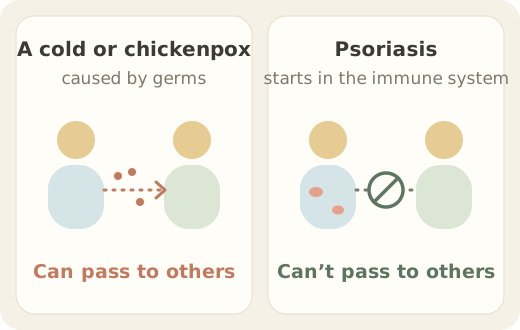
Illnesses like colds or chickenpox are caused by germs — viruses or bacteria — that can move from one person to another. Psoriasis works differently.
The American Academy of Dermatology (AAD) explains that psoriasis happens when the immune system doesn't work as it should. Certain immune cells, called T-cells, normally fight off germs. In psoriasis they also act against the skin. This tells the skin to make new cells far too often, and the extra cells build up into patches.
Because the cause is inside the person's own body, there is no germ in the patches to catch. The AAD, the NHS and the National Psoriasis Foundation all state clearly that psoriasis isn't contagious.
Everyday contact is safe
According to the AAD, you cannot get psoriasis from:
- touching someone's skin, including their patches
- swimming in the same pool
- having sex with someone who has psoriasis
The same goes for hugging, holding hands, sharing a sofa or working side by side. Nobody needs to keep their distance from a person with psoriasis.
Spreading on your own skin is different
Some people say their psoriasis is "spreading". This usually means that new patches have appeared on their own body, or that existing patches have got bigger. That isn't the same as being contagious.
New patches can appear when psoriasis flares. Triggers such as stress, an infection, a skin injury, some medicines, cold dry weather, smoking or heavy drinking can set off a flare, according to the AAD and the NHS. For some people, a cut or scrape can be followed by a new patch in that spot.
If your psoriasis is getting worse or showing up in new places, it's worth telling your doctor. Your treatment may need a review — but don't change or stop a treatment without talking to them first.
It runs in families, but it isn't "caught"
Psoriasis is more common in some families. The AAD says your chance is higher if a parent, grandparent, brother or sister has it. NIAMS adds that researchers have found several genes linked to psoriasis, many of them involved in the immune system.
This can be confusing: if it runs in families, isn't it passed on? The answer is that genes are inherited from your parents at birth. That's not the same as catching something. And genes aren't the whole story — the AAD notes that some people with these genes never get psoriasis, and some people with psoriasis don't have them.
Why the myth hurts
Believing that psoriasis is contagious can lead to stares, comments or people avoiding contact. That can be hard to live with. NIAMS lists low self-esteem, anxiety and depression among the problems linked with psoriasis.
If worry about how others react is affecting your mood, your sleep or what you do day to day, please mention it to your doctor. Feeling low is part of your health too, and support is available.
How to explain it to someone
You don't owe anyone an explanation. But if you'd like to have a few words ready, here are some ideas:
- Short: "It's psoriasis. It's a skin condition from the immune system — it's not contagious."
- A bit more: "My immune system makes my skin grow too fast, so it builds up into patches. You can't catch it, the same way you can't catch someone's allergy."
- For children: "My skin makes new skin too quickly. It's not germs, so you can't catch it."
- At the pool or gym: "It's psoriasis — not an infection, and it isn't contagious."
Some people find it easier to answer once, calmly, and move on. Others prefer to change the subject. Both are fine.
Keeping notes can help
If you notice your skin changes when you're under pressure — for example, before a big event or after a tense conversation — a short diary entry can help you see whether stress is one of your triggers.
Example entry: Thursday. Stressful day; a stranger asked about my arms at the pool. Itch 5/10 in the evening. New small patch on left forearm. Slept OK.
Over a few weeks, these notes can show whether flares follow stressful periods, and they give your doctor something concrete to look at. You can read more about this in our guide to psoriasis flare-up triggers.
Questions to ask your doctor
- Is this definitely psoriasis, or could it be something else?
- What might be making my psoriasis spread to new areas?
- What should I do if I get a cut or scrape on my skin?
- Where can I find support if psoriasis is affecting my confidence or mood?
When to see a doctor
See a doctor if you have a new rash and you're not sure what it is — only a doctor can tell whether it's psoriasis or something else, such as an infection. Also see your doctor if your psoriasis is spreading quickly, your treatment isn't helping, or you have joint pain or swelling.
Seek medical care now if you have widespread red skin, pus-filled bumps with a fever, or feel very unwell — contact your doctor or your local emergency number.
Frequently asked questions
Can I catch psoriasis from sharing towels or clothes?
No. Psoriasis isn't caused by germs, so it can't pass on through towels, clothes or bedding. The NHS does advise not sharing emollients (moisturisers) with other people.
Can a baby get psoriasis from a parent through touch?
No. A child can't catch psoriasis by touch. A child can inherit genes that make psoriasis more likely, but many children of parents with psoriasis never get it.
Is it safe to swim with psoriasis?
Other people can't catch psoriasis from you in the pool. Whether swimming suits your own skin is a good question for your doctor.
Is scalp psoriasis contagious?
No. Psoriasis isn't contagious anywhere on the body, including the scalp and nails.
Sources
- Psoriasis: Causes — American Academy of Dermatology
- Psoriasis — NHS
- About psoriasis — National Psoriasis Foundation
- Psoriasis — National Institute of Arthritis and Musculoskeletal and Skin Diseases (NIAMS)
We check articles against these sources and update them when guidance changes. Read our editorial policy.