 Velvi
Short answer
Scalp psoriasis is psoriasis on the scalp. It causes dry, itchy, flaky patches, from fine, dandruff-like flakes to thick, crusted plaques. It can spread to the hairline, forehead, back of the neck and ears. It isn't contagious, and while there is no cure, treatments can help manage it and gentle hair care can help protect your scalp and hair.
The scalp is one of the most common places for psoriasis to show up. The National Psoriasis Foundation says between 52 and 80 out of every 100 people with psoriasis have had it on their scalp at some point.
What scalp psoriasis looks like
Scalp psoriasis can be very mild or quite severe. According to the National Psoriasis Foundation, it can look like:
- fine scaling that is easy to mistake for dandruff, or
- thick, crusted plaques (raised, scaly patches) that can cover the whole scalp.
On white skin, patches are usually pink or red with silvery-white scale. On brown or black skin, they can look purple, brown or grey. The National Psoriasis Foundation notes that scalp psoriasis is common in people with skin of color, and that some hair types can make treatment harder — worth raising with your doctor.
The common symptoms are:
- flaking — scales that fall onto your shoulders or stick in your hair
- itching — which can be hard to ignore
- dryness and soreness of the skin
- patches past the hairline — on the forehead, the back of the neck, or around and behind the ears
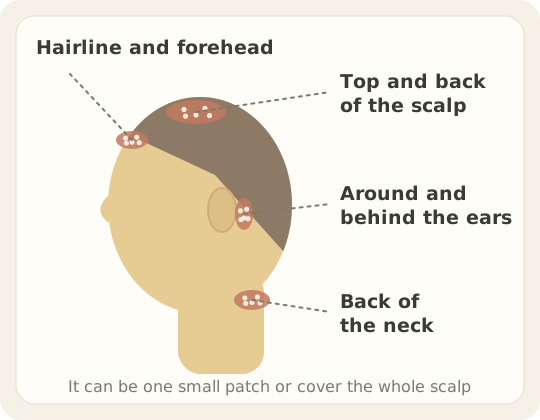
Some people feel embarrassed by scalp psoriasis. The National Psoriasis Foundation calls the scalp a "high-impact" area: even a small patch can affect your quality of life.
Scalp psoriasis, dandruff or something else?
Several scalp conditions look alike. The National Psoriasis Foundation says scalp psoriasis can be mistaken for seborrheic dermatitis (a common scalp condition with flaky, greasy-looking scale) or for eczema. It describes one general difference:
| Scalp psoriasis | Seborrheic dermatitis | |
|---|---|---|
| How scale tends to look | powdery, with a silvery sheen | yellowish and greasy |
This is a rough guide, not a test. Only a doctor can tell which condition you have. We compare them in more detail in Scalp psoriasis vs dandruff.
To find out, a doctor or dermatologist usually looks closely at your scalp. If the diagnosis isn't clear, they may take a tiny skin sample (a biopsy) to check in a lab.
Why it happens
You can't catch scalp psoriasis from someone else, and you can't spread it — the NHS is clear that psoriasis isn't contagious. Like psoriasis anywhere on the body, it starts in the immune system.
Normally, skin cells take about a month to grow and shed. In psoriasis, an overactive immune system speeds this up to just three or four days. The cells pile up on the surface and form scaly patches. Read more in What causes psoriasis? and Is psoriasis contagious?
Certain things can set off a flare. The National Psoriasis Foundation lists common triggers such as:
- stress
- skin injury — including scratching or picking at the scalp
- infections
- some medicines
- smoking and alcohol
- changes in the weather
- diet
The point about injury matters a lot on the scalp. The National Psoriasis Foundation explains that scratching or wounding the skin can make psoriasis worse — doctors call this Koebnerization — so it's best to avoid rubbing or scratching plaques.
Scalp psoriasis and hair loss
The National Psoriasis Foundation says severe scalp psoriasis can, in rare cases, cause temporary hair loss.
Hair can also be lost because of how the scalp is handled. The AAD lists:
- pulling off scale too hard, which takes hair with it
- scratching, which can loosen hair
- dry, brittle hair that breaks more easily
The AAD says hair tends to grow back once the scalp psoriasis clears. If your hair keeps thinning, tell your dermatologist. People lose hair for many reasons, and it may not be the psoriasis.
Gentle care for your scalp and hair
These tips come from the AAD, the National Psoriasis Foundation and MedlinePlus. They are about everyday care, not treatment. Your doctor will guide you on which products or medicines to use.
- Be gentle with scale. Comb or brush slowly with a soft brush. Don't pick or pull scale off — it can irritate the skin and set off a flare.
- Don't scrub. Rubbing hard can irritate the skin.
- Keep nails short and smooth. It's hard not to scratch when you itch. Short nails do less damage.
- Use conditioner after washing. It helps with dryness.
- Let your hair air dry when you can. A hairdryer can dry out the scalp further.
- Patch-test hair products. Hair dye, straighteners and sprays can irritate the scalp. Try a small amount on one spot first and wait a few hours.
- Make sure treatment reaches the skin. The AAD notes that a medicine or medicated shampoo only works if it gets to the scalp, not just the hair. Ask your doctor how to apply yours.
- Talk about your hair routine. The National Psoriasis Foundation suggests discussing how you wash and style your hair with your dermatologist. Hair type and thickness can affect which kind of treatment suits you.
How scalp psoriasis is treated
There is no cure, but treatments can help control scalp psoriasis. The NHS says treatment depends on the type of psoriasis, how severe it is and where it is. For the scalp, your hair type matters too.
The AAD lists these main groups of treatment:
- medicated shampoos, some available without a prescription
- scale softeners, which help loosen thick scale so it can be removed
- medicines put directly on the scalp
- light therapy (treatment with ultraviolet light)
- injections
- biologics (medicines made to target specific parts of the immune system) and other medicines that work throughout the body
The National Psoriasis Foundation adds that body-wide medicines are often used when scalp psoriasis hasn't responded to other treatments.
The skin on the scalp is thick, so the AAD notes that scalp treatments are often stronger than ones used elsewhere. If a treatment feels too harsh or causes side effects, contact your doctor. Talk to them before changing or stopping anything.
Scalp psoriasis can be stubborn. A GP can prescribe some treatments or refer you to a dermatologist, a doctor who specialises in skin. If your scalp psoriasis is hard to clear, the AAD recommends seeing a board-certified dermatologist.
How to track scalp psoriasis in a diary
The scalp is hard to see yourself, so a diary helps you notice changes you'd otherwise miss. You might note:
- where: the crown, behind the ears, hairline, back of the neck
- itch on a scale of 0 to 10, and whether it affects your sleep
- flaking: none, light, or heavy enough to see on clothes
- hair: more hair than usual in the brush or shower drain
- what you used and when, as your doctor advised
- possible triggers: stress, illness, cold weather, a new hair product
- a photo of the same area every week or two, in the same light — ask someone to help with the back of your head
Example entry: Thursday. Behind both ears and along the hairline at the back. Itch 7/10, worse in the evening. Flakes on my dark jumper. Tried a new hair spray on Monday. Stressful week. Noticed a bit more hair in the brush.
Bring your notes and photos to your appointment. They give your doctor a clearer picture than memory alone. An app such as Velvi can keep these notes and photos in one place.
Questions to ask your dermatologist
- Is this scalp psoriasis, or could it be something else, like seborrheic dermatitis?
- Which treatments suit my hair type and how often I wash my hair?
- How should I remove scale without damaging my hair?
- How long should I try a treatment before we review it?
- Is my hair loss from psoriasis, or could there be another cause?
- Can I keep dyeing or styling my hair?
- Should I be checked for psoriatic arthritis?
When to see a doctor
See a GP or dermatologist if you think you might have scalp psoriasis, or if flaking or itching is affecting your sleep or confidence. Go back if your treatment isn't helping or causes side effects, or if you are losing hair.
Psoriatic arthritis is a type of arthritis linked to psoriasis that causes painful, stiff, swollen joints. The National Psoriasis Foundation says about 1 in 3 people with psoriasis may develop it, and notes that many people have both scalp psoriasis and psoriatic arthritis. See a doctor promptly if you have joint pain, stiffness or swelling.
Seek medical care now if you have widespread red skin, pus-filled bumps with a fever, or feel very unwell — contact your doctor or your local emergency number.
Frequently asked questions
Is scalp psoriasis contagious?
No. You can't catch it from someone or pass it on through touch or close contact.
Can scalp psoriasis make your hair fall out?
Severe scalp psoriasis rarely causes hair loss by itself, but removing scale roughly, scratching and dry, brittle hair can. Hair usually grows back once the psoriasis clears.
Can scalp psoriasis spread to my face?
It can reach past the hairline onto the forehead, and also the back of the neck and the skin around the ears. Tell your doctor about every area that's affected.
Will dandruff shampoo help?
Some medicated shampoos sold without a prescription can help. The National Psoriasis Foundation mentions ones containing salicylic acid, coal tar, zinc pyrithione or ketoconazole. Not every dandruff shampoo contains these, so ask a pharmacist or your doctor which kind suits you.
Does scalp psoriasis go away?
It tends to come and go, with flares and calmer periods. There is no cure, but treatment can help keep it under control.
Sources
- Scalp psoriasis — National Psoriasis Foundation
- Scalp psoriasis: Diagnosis and treatment — American Academy of Dermatology
- Scalp psoriasis: 10 ways to reduce hair loss — American Academy of Dermatology
- Psoriasis: Signs and symptoms — American Academy of Dermatology
- Psoriasis — NHS
- Psoriasis — MedlinePlus (U.S. National Library of Medicine)
- Psoriasis: Treatment — NHS
We check articles against these sources and update them when guidance changes. Read our editorial policy.