 Velvi
Short answer
Psoriasis and eczema can both cause red, dry, itchy, scaly skin, but they are different conditions. Psoriasis usually shows as well-defined, thick, scaly patches, often on the elbows and knees. Eczema is often very itchy and tends to appear in the creases of the elbows and knees. They can look alike, and children can have both, so only a doctor can tell which one it is.
If you have a red, itchy patch and can't tell what it is, you are not alone. These two can be hard to tell apart, especially in children. This guide explains the usual differences, why they get mixed up and what to bring to an appointment. It can't tell you which one you have.
"Eczema" here means atopic eczema, also called atopic dermatitis, the most common kind.
Psoriasis vs eczema at a glance
These are general patterns, not rules. Real skin often doesn't follow them.
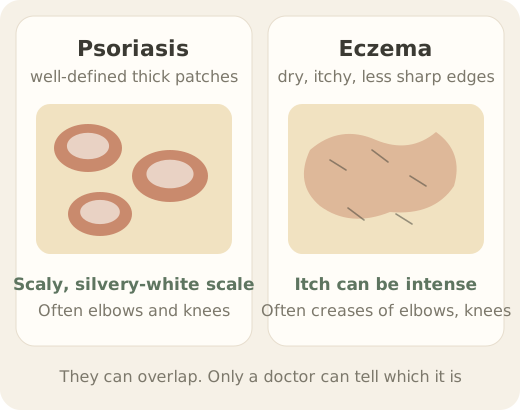
| Psoriasis | Eczema | |
|---|---|---|
| Look | Well-defined, thick, red, scaly patches (AAD). Raised patches covered by silvery-white scales (NIAMS). | Dry, cracked or scaly skin that may blister or bleed (NHS). Scratching can add redness, swelling, oozing and crusting (NIAMS). |
| Common places | Scalp, elbows and knees (NIAMS). | Creases of the knees and elbows (AAD). Also hands, neck and ankles (NIAMS). |
| Itch | Can be itchy and sore (NHS). In children it tends to be mild (AAD). | Itching is the main symptom and can be intense (NIAMS, AAD). |
| When it starts | More common in adults than in children (NIAMS). | Usually starts in babies and young children (NHS). |
| Cause | An immune-mediated disease: skin cells multiply too quickly (NIAMS). | Exact cause unknown. Genes, the immune system and the environment may play a part (NIAMS). |
| Contagious? | No (NHS). | No (NHS). |
What each one looks like
Psoriasis
The NHS describes dry, flaky, itchy and sometimes sore patches with silvery-white scales. On white skin the patches are usually pink or red. On brown or black skin they can look grey and may leave darker marks after they clear. Psoriasis can also affect the nails, causing pits and dents. See Psoriasis symptoms and Plaque psoriasis for more.
Eczema
The NHS says eczema makes skin dry, itchy and cracked or scaly. Colour can look red, white, purple or grey, and patches may be lighter or darker than the skin around them. Scratching can damage the skin and make eczema worse.
Where on the body
Place is one of the clues doctors use. The AAD says psoriasis often appears on the elbows and knees, and in children also on the face, buttocks and scalp. Eczema tends to appear in the creases of the knees and elbows.
Eczema changes with age, according to NIAMS:
- Babies: the face, scalp and the bends of the joints
- Children: the bends of the elbows and knees, the neck and the ankles
- Teens and adults: the hands, neck, elbows and knees, around the eyes, and the ankles and feet
The NHS says psoriasis can also appear in skin folds, such as the groin or under the breasts. See Inverse psoriasis.
Why they get mixed up
Both can be red, dry, itchy and scaly, and both flare up and calm down. The AAD says children can have psoriasis as well as eczema. It also says psoriasis can be hard to tell from eczema in some children. In one Australian study the AAD mentions, most children with psoriasis were first diagnosed with another condition, often eczema.
Itch is a clue, but not a rule. The AAD says eczema itch can be intense and that children with psoriasis tend to have mild itching. But the NHS says psoriasis patches can be itchy and sore too.
Can you have both?
Yes, it can happen. The AAD says some children have both conditions. Sometimes the skin doesn't clearly fit either, and a dermatologist may use the term "psoriasiform dermatitis". If you think you may have both, tell your doctor everything you have noticed.
How doctors tell the difference
The AAD says dermatologists look at how the skin looks, how itchy it is and where the rash is. It says a dermatologist can generally tell the two apart.
That is why a photo from the internet, or your own guess, isn't enough. If a treatment isn't helping, tell your doctor. They may want to review the diagnosis or the plan.
Treatment: why the right diagnosis matters
The NHS says neither eczema nor psoriasis can be cured, but treatment can help manage symptoms. Treatment depends on the diagnosis, so getting it right matters. Don't start, stop or swap any treatment on your own, and don't use a cream meant for one condition on a patch you think is the other. Talk to your doctor first.
How to track a rash while you wait for answers
A diary gives your doctor facts instead of memories. You might record:
- where the patch is, and whether it is in a crease or on the outside of a joint
- how it looks: red or darker, dry, thick, scaly, cracked, weeping
- itch, on a scale of 0 to 10
- what was going on: heat, new soap or detergent, stress, illness, a new medicine
- when it started and whether it has come back in the same place
- what you used, as your doctor advised
- a photo each week, in the same light, kept private
Example entry: Friday. Dry, red patch in the bend of my left elbow, edges not sharp. Itch 7/10, kept me awake. New laundry detergent this week. A smaller thick, scaly patch on my right knee, itch 2/10.
An app such as Velvi can keep these notes and photos together so they are ready for your appointment.
Questions to ask your doctor
- Is this psoriasis, eczema, both or something else?
- What makes you think so, and is any test needed?
- Could the places and the itch pattern point one way?
- Which treatments suit my diagnosis?
- What should I avoid putting on my skin?
- Should I see a dermatologist?
- What should make me come back sooner?
When to see a doctor
See a GP (family doctor) or dermatologist if a rash lasts, keeps coming back, itches badly, disturbs your sleep, or treatment isn't working or causes side effects.
See a doctor promptly if eczema or any rash becomes blistered, crusty or leaking, painful, swollen or warm, suddenly gets worse, or comes with a high temperature — these can be signs of infection. See a doctor promptly too if you have joint pain, stiffness or swelling that keeps coming back — it could be psoriatic arthritis.
Seek medical care now if you have widespread red skin, pus-filled bumps with a fever, or feel very unwell — contact your doctor or your local emergency number.
Frequently asked questions
What is the main difference between psoriasis and eczema?
They are different conditions. Psoriasis is an immune-mediated disease in which skin cells multiply too quickly, per NIAMS. It usually causes well-defined, thick, scaly patches. Eczema is linked to genes, the immune system and the environment, and it is often very itchy.
Is eczema more itchy than psoriasis?
Often, but not always. The AAD says eczema itch can be intense and psoriasis itch tends to be mild in children. Psoriasis can still be itchy and sore, so itch alone can't tell you which you have.
Is psoriasis or eczema contagious?
No. The NHS says you can't catch or spread eczema, and psoriasis is not contagious either. See Is psoriasis contagious?
Can I tell which one I have from a photo?
No. They can look alike, and the AAD says doctors use the look, the itch and the place. See a doctor for a diagnosis.
Sources
- What's the difference between eczema and psoriasis? — American Academy of Dermatology
- What's the difference between eczema and psoriasis? (children) — American Academy of Dermatology
- Atopic eczema — NHS
- Atopic eczema: symptoms — NHS
- Psoriasis — NHS
- Psoriasis: symptoms — NHS
- Atopic dermatitis — National Institute of Arthritis and Musculoskeletal and Skin Diseases (NIAMS)
- Psoriasis — National Institute of Arthritis and Musculoskeletal and Skin Diseases (NIAMS)
We check articles against these sources and update them when guidance changes. Read our editorial policy.