 Velvi
Short answer
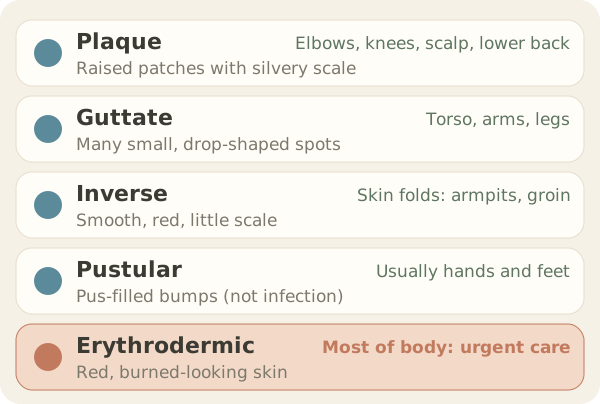
There are five main types of psoriasis: plaque, guttate, inverse, pustular and erythrodermic. Plaque is by far the most common, affecting 80 to 90 percent of people with psoriasis, according to the National Psoriasis Foundation. The types differ in how the skin looks and where it shows up. The serious forms, erythrodermic psoriasis and widespread pustular psoriasis, are rare but need urgent medical care.
This guide explains each main type in plain words, so you can describe what you see to a doctor. It can't tell you which type you have — only a doctor can do that, and a doctor can tell you if more than one applies.
Lists differ a little between organizations. The National Psoriasis Foundation (NPF) and NIAMS, part of the US National Institutes of Health, name five types. The American Academy of Dermatology (AAD) also describes nail psoriasis. The scalp is a place on the body rather than a separate type here.
Plaque psoriasis
This is the type most people mean when they say "psoriasis". The NPF says 80 to 90 percent of people with psoriasis have it.
- Look: raised, red patches covered with silvery-white scale. The AAD says they may itch.
- Skin of color: the NPF says plaques can look darker and thicker, and may be purple, gray or dark brown.
- Where: the AAD lists the scalp, elbows, knees and lower back, but it can appear anywhere.
More in Plaque psoriasis.
Guttate psoriasis
"Guttate" means drop-shaped. The AAD describes small, scaly, salmon-to-pink bumps that appear quite suddenly, mainly on the torso, arms and legs.
It often affects children and young adults, often after an infection such as strep throat. The AAD says it may clear in weeks or months, but it can come back or be followed by plaque psoriasis. The NPF says about 8 in 100 people with psoriasis have this type.
More in Guttate psoriasis.
Inverse psoriasis
Inverse psoriasis (so called because it appears in the body's folds, not on the outer surfaces) forms where skin touches skin. The AAD lists the armpits, genitals and the crease of the buttocks. NIAMS adds under the breasts and the groin.
It looks different from plaque psoriasis: patches are smooth, red and raw-looking with little scale. The AAD says they can be sore or painful. NIAMS says rubbing and sweating can make it worse.
Pustular psoriasis
Pustular psoriasis ("pustular" means pus-filled bumps) causes pus-filled bumps on red, swollen skin. The AAD says the bumps are not an infection.
There are two broad forms:
- Limited to the hands and feet. This is the usual pattern, according to the AAD and NIAMS. The AAD says the skin can be very sore or painful.
- Widespread. Most of the skin turns red and tender, then fills with pus-filled bumps. The AAD says the person often feels very sick, with fever, headache or muscle weakness, and calls it serious and life-threatening.
Erythrodermic psoriasis
"Erythrodermic" means widespread redness. NIAMS calls this type rare. The AAD describes skin over most of the body that looks burned, sometimes with chills, fever, weak muscles, a fast pulse and severe itch. It says this needs immediate medical care.
NIAMS says a severe sunburn or certain medicines can set it off. Don't stop or change a medicine because of this — talk to your doctor first.
Nail psoriasis
Psoriasis can affect fingernails and toenails. The AAD lists tiny dents (pits), white, yellow or brown color changes, crumbling or rough nails, and nails lifting away from the nail bed. Show nail changes to a doctor, who can tell whether psoriasis is the cause.
Psoriasis on the scalp and other places
Where psoriasis appears is not the same as its type. The NPF says around half of people with psoriasis have it on the scalp or face, and up to two-thirds have genital involvement. The AAD notes guttate spots can also appear on the face, scalp and ears. See Scalp psoriasis.
Can the type change?
Sometimes. The AAD says guttate psoriasis may clear and plaque psoriasis appear later, and the NPF says guttate can come back too. If your skin looks different from before, tell your doctor.
How to track your type in a diary
Notes make it easier for a doctor to see which type you have and whether it changes. You could record:
- where on the body the patches are, and whether in skin folds, hands, feet or nails
- how they look: raised patches, small spots, smooth red skin, pus-filled bumps
- itch, soreness or pain from 0 to 10
- anything new before it started, such as an infection, sunburn or a new medicine
- a photo of the same area once a week, in the same light
Example entry: Smooth red patch under my left breast, sore when I sweat, no real scale. Pain 3/10. Different from the dry patches on my elbows. Photo taken.
A diary app such as Velvi can keep these notes and photos in one place.
Questions to ask your doctor
- Which type of psoriasis do I have, and could it be something else?
- Do I have more than one type?
- Is this type likely to change over time?
- Which signs mean I should come back sooner?
- Does my type affect which treatments are suitable?
- Should my nails or joints be checked?
When to see a doctor
See a GP (family doctor) or dermatologist if you think you have psoriasis, if your treatment isn't working or causes side effects, or if you notice a new type of rash. The NHS also advises seeing a doctor for joint pain, stiffness or swelling that keeps coming back — it could be psoriatic arthritis.
The NHS says to call 999 (UK) or go to A&E, or call your local emergency number, if you have psoriasis and your skin quickly turns red with white pus-filled bumps that join together, patches on your feet turn yellow-brown and fill with pus, or red, scaly, pus-filled bumps appear on your fingertips or toes — especially with a fast heartbeat, high temperature, or feeling hot, cold or shivery. Don't drive yourself: ask someone to take you or call for an ambulance.
Seek medical care now if you have widespread red skin, pus-filled bumps with a fever, or feel very unwell — contact your doctor or your local emergency number.
Frequently asked questions
How many types of psoriasis are there?
The NPF and NIAMS name five main types: plaque, guttate, inverse, pustular and erythrodermic. The AAD also describes nail psoriasis.
What is the most common type of psoriasis?
Plaque psoriasis. The NPF says 80 to 90 percent of people with psoriasis have it.
Which type of psoriasis is the most serious?
The AAD calls widespread pustular psoriasis serious and life-threatening, and says erythrodermic psoriasis needs immediate medical care. NIAMS says erythrodermic psoriasis can be very serious. NIAMS and the AAD call these forms rare.
Can you have more than one type of psoriasis?
The sources we used don't say how common this is, but the AAD says guttate psoriasis may be followed by plaque psoriasis, so the type can change over time. A doctor can tell you which type you have.
Are any types of psoriasis contagious?
No. The NHS says psoriasis is not contagious, so you cannot catch it or spread it. See Is psoriasis contagious?
Sources
- About psoriasis — National Psoriasis Foundation
- Guttate psoriasis — National Psoriasis Foundation
- Psoriasis: Signs and symptoms — American Academy of Dermatology
- Psoriasis — NHS
- Psoriasis — National Institute of Arthritis and Musculoskeletal and Skin Diseases (NIAMS)
We check articles against these sources and update them when guidance changes. Read our editorial policy.