 Velvi
Short answer
Guttate psoriasis is a type of psoriasis that causes many small, drop-shaped spots, often on the chest, back, arms and legs. It usually appears suddenly, most often in children and young adults, and often after an infection such as strep throat. It isn't contagious. It may clear within weeks or months, but in some people it comes back or turns into plaque psoriasis.
Have small, scaly spots suddenly appeared on your skin or your child's skin, perhaps after a sore throat? This guide explains what guttate psoriasis looks like, why infections matter, how long it can last and what to ask your doctor.
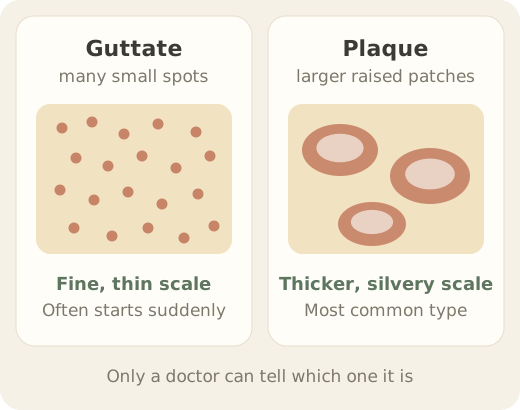
Guttate psoriasis is much less common than plaque psoriasis. The National Psoriasis Foundation (NPF) says about 8 out of every 100 people with psoriasis have this type. Plaque psoriasis, with larger raised patches, is the most common type — see Plaque psoriasis.
What guttate psoriasis looks like
"Guttate" comes from the Latin word for a drop. MedlinePlus (from the US National Library of Medicine) describes the spots as teardrop-shaped, which is why some people call it "teardrop psoriasis".
The spots are:
- small — the American Academy of Dermatology (AAD) calls them tiny bumps
- many — they often cover a large part of the body at once
- round or drop-shaped, with a fine, flaky scale on top
- often itchy — MedlinePlus lists itching as a symptom
Colour depends on your skin tone:
- On white skin, the spots are usually pink, red or salmon-coloured.
- On brown or black skin, the NPF says the spots may not look red or scaly. They may look brown or violet instead, which can make the condition harder to recognise.
The NPF says the scale is usually thinner than the classic silvery scale of plaque psoriasis.
Where the spots appear
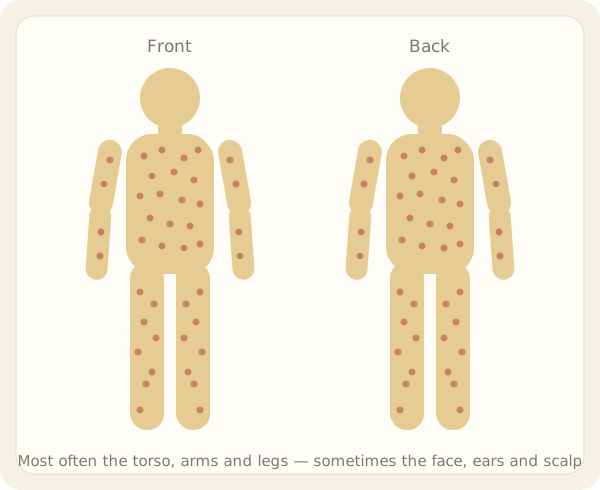
The spots usually appear on the:
- torso (chest, tummy and back)
- arms
- legs
The NPF and the AAD say they can also appear on the face, ears and scalp. Some people have guttate spots and another type of psoriasis, such as plaque psoriasis, at the same time.
Read about the signs of every type in Psoriasis symptoms.
Why it often follows strep throat
Strep throat is a throat infection caused by bacteria called group A streptococcus. MedlinePlus says guttate psoriasis usually appears after an infection, most notably strep throat. NIAMS (part of the US National Institutes of Health) says outbreaks are often set off by an infection of the nose, throat or airways, such as strep throat.
Psoriasis starts in the immune system. The NPF explains that an overactive immune system speeds up skin cell growth. Cells that normally take about a month to grow now take a few days, so they pile up on the surface.
MedlinePlus says the exact cause of guttate psoriasis is unknown, but genes and the immune system are thought to play a part. So an infection is a trigger that can set it off, not the root cause. Read more in What causes psoriasis?
Things that can set off guttate psoriasis include:
- strep infections, such as strep throat — the NPF calls strep a common trigger
- other infections — the NPF names flu, sinus infections, tonsillitis and other infections of the nose and throat
- skin injuries — MedlinePlus mentions cuts, burns and insect bites
- stress
- some medicines — the NPF names antimalarials and beta blockers (used for some heart conditions)
- sunburn and heavy alcohol use, according to MedlinePlus
Don't stop or change a medicine because you think it's a trigger. Talk to your doctor first.
Is guttate psoriasis contagious?
No. Guttate psoriasis can't spread from one person to another, says MedlinePlus. The NHS says the same about psoriasis in general.
That means a child with guttate psoriasis can't pass it to classmates.
The spots are your immune system reacting, not an infection on your skin. See Is psoriasis contagious?
How long does guttate psoriasis last?
No one can say for sure, and the main sources describe it a little differently.
- It can clear on its own. The AAD says guttate psoriasis is often temporary and may clear in a few weeks or months, sometimes without treatment. It adds that the spots may clear once the infection does.
- It may also go away with treatment. The NPF says it may go away on its own or with treatment.
- It can last longer. MedlinePlus says it may become long-term (chronic) or develop into plaque psoriasis. The NPF also says that in some people it turns into plaque psoriasis.
The sources we used don't describe set "stages of healing". A weekly photo of the same area is the best way to see how your own spots are changing.
The AAD describes the different ways it can go after a first flare-up:
- it never comes back
- it lasts for life
- it clears, and plaque psoriasis appears later
- plaque psoriasis appears alongside it
The AAD says there is no way to predict which of these will happen. A diary helps you notice patterns and gives your doctor a clearer picture.
How guttate psoriasis is diagnosed
A doctor can usually tell what it is by looking at your skin. MedlinePlus says people with guttate psoriasis have often had a recent sore throat or a cold-like infection, so your doctor will likely ask about that. Tests can include:
- a throat swab (throat culture): a cotton bud is rubbed on the back of the throat and tested for strep bacteria
- a blood test for signs of a recent strep infection
- a skin biopsy, where a tiny piece of skin is taken and looked at under a microscope
Several other rashes can look similar. The NPF names other skin conditions, such as pityriasis rosea, tinea versicolor and lichen planus, that can be mistaken for it. That's why it's worth seeing a doctor rather than guessing — only a doctor can tell what it is.
How it's treated
There is no cure for psoriasis, but treatments can help manage it. The NPF lists three main groups for guttate psoriasis:
- topicals — creams, ointments and other treatments put on the skin, some available without a prescription
- phototherapy — controlled treatment with ultraviolet light
- systemic treatments — medicines that work throughout the body, taken by mouth or as biologics (medicines that target specific parts of the immune system)
MedlinePlus says milder cases are often treated at home with creams, medicated shampoos and moisturisers. More severe cases may be treated with medicines that work on the immune system. Light therapy may also be used, and MedlinePlus says guttate psoriasis may clear completely after treatment, especially light therapy.
If tests show a recent strep infection, MedlinePlus says antibiotics may be given for the infection. The sources we used don't say whether this makes the spots clear faster, so ask your doctor what to expect.
The NHS says the right treatment depends on the type of psoriasis, how severe it is and where it is. Your GP (family doctor) can help or refer you to a dermatologist, a doctor who specialises in skin. Talk to your doctor before starting, stopping or changing any treatment.
How to track guttate psoriasis in a diary
Guttate psoriasis can change quickly, and it's easy to forget what it looked like at its worst. Short notes help you and your doctor see how it is going. You might record:
- when the spots started, and any sore throat, cold or other illness in the weeks before
- where the spots are: chest, back, arms, legs, scalp, face
- how many — a rough guess is fine: a few, dozens, or too many to count
- itch, on a scale of 0 to 10, and whether it affects sleep
- change: are the spots fading, the same or spreading?
- possible triggers: stress, a new medicine, sunburn, a skin injury
- what you used, as your doctor advised
- a photo of the same area once a week, in the same light and from the same distance
Example entry: Day 10. Sore throat about two weeks before the spots started. Spots on my chest, back and both thighs, maybe 50 or more. Itch 4/10, didn't wake me. Fewer new spots this week; older ones look paler. Photo of my back taken.
If guttate psoriasis comes back later, these notes show your doctor whether it followed an infection again. An app such as Velvi can keep your notes and photos in one place.
Questions to ask your doctor
- Is this guttate psoriasis, or could it be another rash?
- Should I be tested for strep or another infection?
- Is it likely to clear by itself, or do you suggest treatment?
- Which type of treatment suits the amount of skin affected?
- What should I do about the itch?
- What should I watch for in case it turns into plaque psoriasis?
- What should I do if it comes back after another sore throat?
- Could the infection before it need treatment too?
When to see a doctor
See a GP (family doctor) or dermatologist if you have small scaly spots that appeared suddenly, especially after a sore throat — a doctor can check whether it's guttate psoriasis and whether you have an infection. Go back if the spots are spreading, aren't improving, or your treatment isn't helping or causes side effects.
See a doctor promptly if you have joint pain, stiffness or swelling — it could be psoriatic arthritis.
Seek medical care now if you have widespread red skin, pus-filled bumps with a fever, or feel very unwell — contact your doctor or your local emergency number.
Frequently asked questions
Is guttate psoriasis contagious?
No. You can't catch guttate psoriasis from someone or pass it on to anyone else.
Does guttate psoriasis go away?
It may. The AAD says it may clear within a few weeks or months, sometimes without treatment, and may never return. In some people it comes back or turns into plaque psoriasis, and there's no way to know in advance which will happen.
Can adults get guttate psoriasis?
Yes. It is most common in children and young adults, but the NPF says it can start at any age.
Can guttate psoriasis come back?
It can. Some people have only one episode. Others have it again later, or go on to have plaque psoriasis. Tell your doctor if the spots return.
Is guttate psoriasis the same as plaque psoriasis?
No. Both are types of psoriasis, but guttate psoriasis causes many small spots with a fine scale, while plaque psoriasis causes larger, thicker raised patches. Some people have both. Read more in Plaque psoriasis.
Sources
- Guttate psoriasis — National Psoriasis Foundation
- Psoriasis: Signs and symptoms — American Academy of Dermatology
- Guttate psoriasis — MedlinePlus (U.S. National Library of Medicine)
- Psoriasis — MedlinePlus (U.S. National Library of Medicine)
- Psoriasis — National Institute of Arthritis and Musculoskeletal and Skin Diseases (NIAMS)
- Psoriasis — NHS
We check articles against these sources and update them when guidance changes. Read our editorial policy.