 Velvi
Short answer
Inverse psoriasis is a type of psoriasis that appears in skin folds, such as the armpits, under the breasts, the groin and between the buttocks. The patches are usually smooth, red or darker than the skin around them, and often sore or itchy, with little or no scale. It isn't contagious, and it can look like a fungal rash, so it's worth getting checked by a doctor.
Red, raw skin in a fold is uncomfortable and easy to worry about. This guide explains what inverse psoriasis looks like, why folds are affected, how it differs from look-alike rashes, and what to ask your doctor.
Inverse psoriasis is also called flexural or intertriginous psoriasis. The National Psoriasis Foundation (NPF) says it affects 21 to 30 out of every 100 people with psoriasis.
What inverse psoriasis looks like
Skin folds are moist, so the patches usually don't build up the thick, silvery scale of plaque psoriasis. The American Academy of Dermatology (AAD) describes smooth, red patches that look raw, with little or no scale. The NPF says they may look shiny.
Colour depends on your skin tone:
- On lighter skin, the patches are usually red.
- On skin of colour, the NPF says they may look purplish, brown or darker than the skin around them.
The skin can be itchy and sore. The NPF says the itching and pain can be severe, and that rubbing and sweating can make it worse.
Many people with inverse psoriasis also have another type elsewhere on the body, such as plaque psoriasis. See Plaque psoriasis for how that type looks.
Where it appears
Inverse psoriasis develops where skin touches skin. The NPF lists:
- the underarms
- under the breasts
- the genital area
- between the buttocks
- under the buttocks
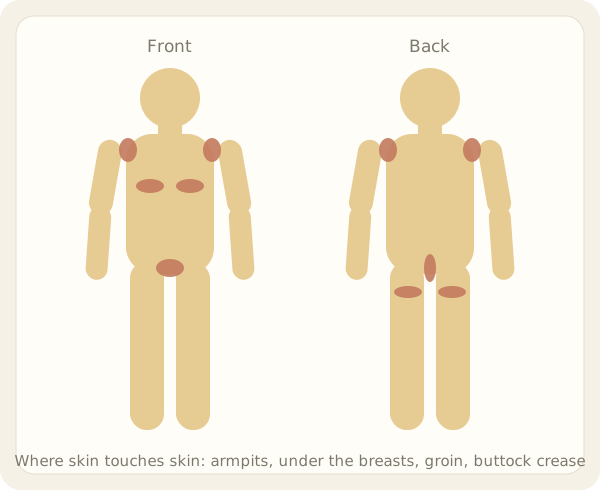
The NHS also lists the groin, the genitals and under the breasts as places psoriasis can appear in the folds of the body.
The NPF says it is more common in people who are overweight or who have deep skin folds. Anyone can get it, and it can start at any age, including in infancy, where it can show up as psoriatic diaper rash.
Skin-fold psoriasis can affect daily life more than the size of the patch suggests, the NPF says. That is a good reason to tell your doctor how much it bothers you, not only how big it is.
Inverse psoriasis or a fungal rash?
Other rashes are also common in skin folds. The NPF says inverse psoriasis can be mistaken for intertrigo (irritated skin where skin rubs together) or for fungal infections. Both are also itchy and inflamed.
The NPF adds that skin folds are prone to yeast and fungal infections. So a doctor may check for infection too, and sometimes use a combination of treatments.
You can't tell these apart by looking at them yourself. The NPF says doctors usually diagnose inverse psoriasis from how it looks, where it is and how itchy it is. A skin biopsy, where a tiny piece of skin is examined, is only needed if the diagnosis is unclear. Only a doctor can tell which rash you have.
Why it flares
NIAMS describes psoriasis as an immune-mediated disease. Read more in What causes psoriasis?
The NPF lists things that can bring on or worsen a flare:
- friction on deep skin folds
- skin injury
- infections
- stress
- tobacco or alcohol use
- certain medicines, or starting or stopping a medicine
Don't stop or change a medicine because you suspect it. Talk to your doctor first.
The NPF says there is no known way to prevent psoriasis, but managing triggers may reduce flares.
Is it contagious?
No. Psoriasis can't be passed from person to person, even in intimate areas. If you also have an itchy rash in the folds, a doctor can check for infections that need their own care. See Is psoriasis contagious?
How inverse psoriasis is treated
The NHS says psoriasis can't be cured, and the NPF says treatments can improve symptoms. The NHS says the right treatment depends on the type of psoriasis, how severe it is and where it is on your body.
The NPF lists three groups of treatment for inverse psoriasis:
- topical treatments — creams and ointments put on the skin, including some steroid and some non-steroid products
- phototherapy — controlled treatment with ultraviolet light
- systemic treatments — medicines that work throughout the body, such as tablets or biologic medicines
Skin in the folds is thin and delicate. The NPF says the strongest topical steroids are generally not suited to skin folds, while other steroids and several non-steroid options can be used. So use only what your doctor or pharmacist advises for these areas.
The NPF considers all people with inverse psoriasis to be candidates for systemic treatment. Ask your doctor which option is right for you.
Because folds are prone to yeast and fungal infections, the NPF says a doctor may recommend drying powders. It also says not to cover skin folds unless a health care provider directs it.
The NHS says to see your GP if you think you have psoriasis, or if treatment isn't working or causes side effects. There is no single fix for friction and sweat, so ask your doctor what suits your skin. Talk to your doctor before starting, stopping or changing any treatment.
How to track inverse psoriasis in a diary
Notes help you spot what makes the folds worse and give your doctor a clear picture. You might record:
- where: which folds are affected, and on which side
- how it looks: red or darker, smooth, cracked, wet
- itch and pain, each on a scale of 0 to 10
- friction and sweat: a hot day, a workout, a long walk, tight clothes
- other possible triggers: stress, illness, a new medicine, a skin injury
- what you used, as your doctor advised
- how much it affected your day: sleep, exercise, work, intimacy
- a photo of the area once a week, in the same light, if you are comfortable and keep it private
Example entry: Tuesday. Both armpits red and sore, right side worse. Itch 5/10, pain 4/10. Long walk in the heat yesterday. Used the cream my doctor advised. Painful when I raise my arm to wash my hair.
An app such as Velvi can keep these notes and photos in one private place, so they're ready for your appointment.
Questions to ask your doctor
- Is this inverse psoriasis, or could it be a fungal infection or another rash?
- Could I have more than one thing at the same time?
- Which treatments suit skin folds?
- Which treatments are right for me, including medicines that work throughout the body?
- What can I do about the friction and sweat?
- Do I have psoriasis elsewhere on my body?
- How often should I come back, and what should make me return sooner?
When to see a doctor
See a GP (family doctor) or dermatologist if you have a red, sore or itchy rash in your skin folds that doesn't settle or keeps coming back. Go back if your treatment isn't working or causes side effects.
See a doctor promptly if you have joint pain, stiffness or swelling that keeps coming back — it could be psoriatic arthritis.
Seek medical care now if you have widespread red skin, pus-filled bumps with a fever, or feel very unwell — contact your doctor or your local emergency number.
Frequently asked questions
Is inverse psoriasis the same as flexural psoriasis?
Yes. The NPF says inverse psoriasis is also called intertriginous psoriasis or flexural psoriasis.
Why is there no scale on inverse psoriasis?
Skin folds are moist. The NPF says that's why the patches look smooth and shiny and usually lack the scale seen in plaque psoriasis.
Where does inverse psoriasis appear?
The NPF lists the underarms, under the breasts, the genital area, between the buttocks and under the buttocks. Many people also have another type of psoriasis elsewhere. See Types of psoriasis.
Is inverse psoriasis a fungal infection?
No, but the two can look alike. Only a doctor can tell which one it is.
Does inverse psoriasis go away?
The NPF says psoriasis is lifelong, and symptoms can clear and come back. Treatment can improve symptoms.
Can I use any cream on it?
Ask your doctor or pharmacist first. Skin in the folds is delicate, and the NPF says the strongest topical steroids are generally not suited to it.
Sources
- Inverse psoriasis — National Psoriasis Foundation
- Psoriasis: Signs and symptoms — American Academy of Dermatology
- Psoriasis — National Institute of Arthritis and Musculoskeletal and Skin Diseases (NIAMS)
- Psoriasis: symptoms — NHS
- Psoriasis: treatment — NHS
We check articles against these sources and update them when guidance changes. Read our editorial policy.