 Velvi
Short answer
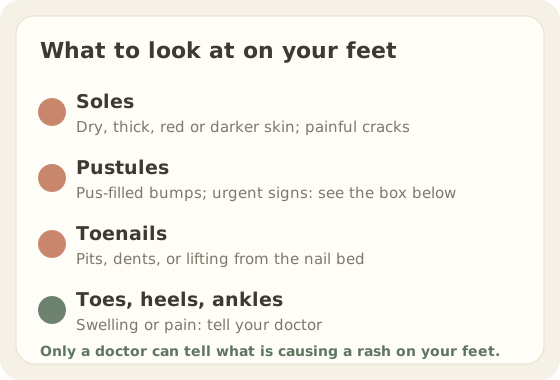
Psoriasis on the feet usually affects the soles. Skin can turn dry, thick and red or darker, often with painful cracks, or it can form small pus-filled bumps. It is not contagious, and treatments can help manage it. Other conditions, such as athlete's foot, can look similar, so ask a doctor to confirm what it is.
This guide covers how psoriasis can look on the feet, why it can make walking hard, what may set it off, and what to tell your doctor.
How psoriasis can look on the feet
Psoriasis on the soles (and the palms of the hands) is called palmoplantar psoriasis. The National Psoriasis Foundation (NPF) describes a plaque type and a pustular type:
- Plaque type. Skin is discolored or red, dry and thickened, often with deep, painful cracks (fissures). See Plaque psoriasis.
- Pustular type. Pus-filled bumps appear on the soles. The NPF calls this palmoplantar pustulosis. See Pustular psoriasis.
The NHS describes another sign: lots of small brown and yellow spots on the palms of the hands and soles of the feet. Redness can be harder to see on brown or black skin. We use a diagram here instead of photos, because skin looks different from person to person.
The NPF says this type affects roughly 12 to 16 out of every 100 people who have psoriasis. If you have it on your feet, you are not alone.
Psoriasis can also change the nails. The NHS says the nail surface can get dents and pits.
Why feet are a big deal
You use your feet all day. The NPF says psoriasis on the palms and soles can make walking painful and limit the use of the hands and feet. The NPF also cites research in which people with palmoplantar psoriasis were almost twice as likely to report mobility problems.
If walking hurts, tell your doctor. It is a good enough reason to book a visit on its own.
What may set it off
The NPF lists these triggers: stress, certain medicines, smoking, alcohol, skin injury, infections, weather changes and diet. Don't stop a medicine because you suspect it. Ask your doctor first.
Is it psoriasis or athlete's foot?
Athlete's foot is a common fungal infection. The NHS says one of the main signs is itchy white patches between the toes. It can also cause sore, flaky patches and cracked skin, can affect the soles and sides of the feet, and sometimes causes blisters.
So both conditions can leave the feet flaky, sore and cracked. Unlike psoriasis, athlete's foot is contagious. You can catch it from walking barefoot in places such as changing rooms.
According to the NPF, a doctor looks at how the skin appears, where it is and how itchy it is. They may also take a small skin sample. Only a doctor can tell which one it is. For a similar comparison, see Psoriasis vs eczema.
Treatment options, at a high level
There is no cure for psoriasis, NIAMS says, but treatment aims to keep symptoms under control. The NPF says foot psoriasis is hard to treat, so you may need to try several options before finding one that works. The main groups are:
- topical treatments: creams and ointments, including steroid and non-steroid ones
- phototherapy: light treatment
- systemic treatments: tablets or injections that work throughout the body
The NPF says a provider may suggest covering a treated area, for example with cotton socks, to help a cream or ointment work better. Do this only if your provider tells you to. Talk to your doctor before starting, stopping or changing any treatment.
Everyday skin care
NIAMS's general advice for psoriasis is lukewarm water, mild soap with added oils, and a heavy moisturizer applied while the skin is still damp. Ask your doctor what suits your feet.
Toes and between the toes
The skin between the toes is also where athlete's foot often shows up, according to the NHS, so don't guess the cause. If the skin on or between your toes is itchy, flaky, sore or cracked, ask a pharmacist or doctor. The NHS says pharmacists can recommend treatments for athlete's foot. If you also have psoriasis on your hands, see Psoriasis on hands.
Sore toes, heels or ankles
Psoriasis can come with psoriatic arthritis, which affects the joints. The NPF says roughly 1 in 3 people with psoriasis also have it, and the skin symptoms usually come first.
Signs the NPF lists that can involve the feet:
- pain in and around the feet and ankles
- "sausage-like" swelling of a whole toe
- inflammation where tendons and ligaments attach to bone
- nail pitting, or the nail lifting from the nail bed
Early diagnosis and treatment can relieve symptoms and may help prevent permanent joint damage, the NPF says. If your toes, feet or ankles hurt or swell, tell your doctor, even if the skin looks mild.
How to track foot psoriasis in a diary
A diary shows your doctor how your feet change from week to week. You might note:
- where: soles, toes, between the toes, heels, nails
- how it looks: dry, thick, red or darker, cracked, bumpy
- pain and itch, each from 0 to 10
- walking: how far you walked and whether it hurt
- possible triggers: a cut or blister, stress, an illness, cold weather
- joints and toes: swelling or stiffness, and how long it lasted
- what you used on your feet, as your doctor advised
- photos, if you wish, taken in the same light
Example entry: Monday. Both soles: dry, thick, three cracks on the left heel that sting. Pain 6/10, itch 2/10. Walked 10 minutes to the bus and had to stop twice. Stressful week and cold weather. Left big toe a little swollen this morning.
An app such as Velvi can keep these notes and photos in one private place for your appointment.
Questions to ask your doctor
- Is this psoriasis, a fungal infection or something else? Do I need a skin sample?
- Which treatments suit my feet, and how will we know if they work?
- Should I cover my feet after applying a treatment?
- Could my nail changes or sore toes mean psoriatic arthritis?
- Should I see a dermatologist or a rheumatologist (a joint specialist)?
- When should I come back if it doesn't improve?
When to see a doctor
See a GP (family doctor) or dermatologist if you have a rash on your feet that doesn't settle, hurts, cracks, or makes walking hard, or if a treatment isn't working or causes side effects.
See a doctor promptly if you have toe, foot or ankle pain, stiffness or swelling that keeps coming back — it could be psoriatic arthritis.
See a doctor soon if you have diabetes or a weakened immune system, or if your foot or leg is hot, red and painful. The NHS lists these for athlete's foot.
Seek medical care now if you have widespread red skin, pus-filled bumps with a fever, or feel very unwell — contact your doctor or your local emergency number.
The NHS also says to get urgent help (999 or A&E in the UK) if patches on your feet turn yellow-brown and fill with pus, or if your fingers or toes have red, scaly, pus-filled bumps on the tips. Don't drive yourself.
Frequently asked questions
What does psoriasis on the feet look like?
It can look like dry, thick, red or darker skin on the soles with painful cracks, or like pus-filled bumps, according to the NPF. Nails can show pits and dents.
Is psoriasis on the feet contagious?
No. The NHS says psoriasis is not contagious, so you cannot catch it or spread it. Athlete's foot, which can look similar, is contagious.
Why do the soles of my feet crack with psoriasis?
The NPF says plaque psoriasis on the soles makes skin dry and thick, which often leads to deep, painful cracks. Ask your doctor how to care for cracked skin.
Can psoriasis on the feet go away?
NIAMS says psoriasis can't be cured, but treatment aims to control symptoms. A diary can help you spot patterns to discuss with your doctor.
Can sore toes or heels be a sign of psoriatic arthritis?
They can be. The NPF says roughly 1 in 3 people with psoriasis have psoriatic arthritis, and it can cause pain around the feet and ankles and swollen toes. Tell your doctor about joint pain or swelling.
Do I have psoriasis or athlete's foot?
They can look alike, and only a doctor can tell which one it is. A doctor looks at appearance, location and itch, and may take a skin sample.
Sources
- Palmoplantar psoriasis — National Psoriasis Foundation
- Psoriasis: symptoms — NHS
- About psoriatic arthritis — National Psoriasis Foundation
- Athlete's foot — NHS
- Psoriasis: diagnosis, treatment and steps to take — National Institute of Arthritis and Musculoskeletal and Skin Diseases (NIAMS)
We check articles against these sources and update them when guidance changes. Read our editorial policy.