 Velvi
Short answer
Psoriasis on the hands can show up as dry, thick, red or darker skin, often with painful cracks, on the palms. It can also affect the nails. It is not contagious, and treatments can help manage it. Because eczema and other conditions can look similar, ask a doctor to confirm what it is.
This guide covers how psoriasis can look on the hands, why it can be tough to live with, what may set it off, and how to describe it to your doctor.
How psoriasis can look on the hands
Psoriasis on the palms (and the soles of the feet) is called palmoplantar psoriasis. It can appear in two main ways, according to the National Psoriasis Foundation (NPF):
- Plaque type. Skin is discolored, red, dry and thickened, often with deep, painful cracks (fissures). See Plaque psoriasis.
- Pustular type. Small pus-filled bumps appear on the palms and soles. The NPF says the pus is sterile, meaning it isn't caused by infection. See Pustular psoriasis.
The NHS also describes lots of small brown and yellow spots on the palms and soles.
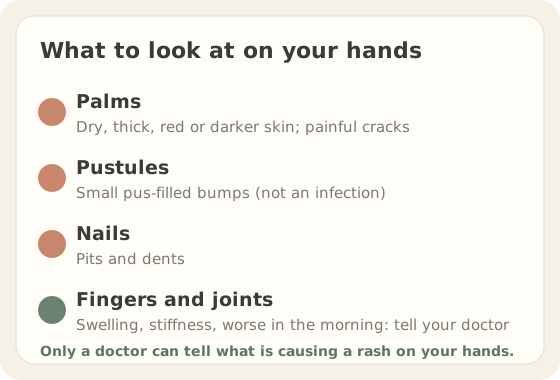
Psoriasis can also affect the nails. The NHS says the surface of the nails can have dents and pits. If you have nail changes, mention them to your doctor, because a doctor usually checks the skin, scalp and nails together, according to NIAMS.
Why hands are a big deal
The NPF calls the hands and feet a "high-impact site". Psoriasis there can affect quality of life no matter how much skin is involved. Painful cracks can make holding things, typing or walking hard.
The NPF cites research in which people with palmoplantar psoriasis were almost twice as likely to report mobility problems, and almost 2.5 times as likely to report trouble with daily activities. If your hands hurt, tell your doctor.
What may set it off
The NPF lists these triggers for psoriasis on the palms and soles: stress, certain medicines, smoking, alcohol, skin injury, infections, weather changes and diet. The NHS adds that cuts, scratches and grazes can cause a flare-up.
Triggers differ from person to person, and some flares have no clear cause. Don't stop a medicine because you suspect it. Ask your doctor first.
Is it psoriasis or eczema?
Eczema is also common on the hands. The NHS lists the hands among the usual places for eczema, and NIAMS lists the hands as a common site for teens and adults. Both can leave skin dry, red or darker, itchy and cracked.
NIAMS describes eczema itch as often intense, and says people with eczema often also have asthma or allergies. Psoriasis can itch too, so you can't tell them apart this way. The NPF says a provider may look at how the skin looks, where it is and how itchy it is, and a skin biopsy (a small skin sample) may help tell psoriasis from other conditions.
Other skin conditions can also look like this, and only a doctor can tell which one it is. See Psoriasis vs eczema for the general differences.
Treatment options, at a high level
There is no cure for psoriasis, NIAMS says, but treatment aims to control symptoms. The NPF says hand and foot psoriasis is hard to treat, so you may need to try more than one option. The main groups are:
- topical treatments: creams and ointments, some from a pharmacy and some prescribed, steroid and non-steroid
- phototherapy: controlled ultraviolet light
- systemic treatments: tablets or injections that work throughout the body
The NPF says a provider may suggest covering a treated area with cotton or plastic gloves to help a cream work. Do this only if your provider tells you to. Talk to your doctor before starting, stopping or changing any treatment.
Everyday skin care
NIAMS's general advice for psoriasis is lukewarm water, mild soap with added oils, and a heavy moisturizer applied while the skin is still damp. Ask your doctor what suits your hands.
Joint pain: a reason to tell your doctor
Psoriasis can come with psoriatic arthritis, which affects the joints. The NPF says about 1 in 3 people with psoriasis also have it, usually after the skin symptoms start.
Signs the NPF lists include:
- pain, swelling and stiffness in joints, often worse in the morning or after rest
- red, discolored or warm joints
- "sausage-like" swelling of a whole finger or toe
- nail pitting, or the nail lifting from the nail bed
Early diagnosis and treatment can relieve symptoms and may help prevent permanent joint damage, the NPF says. If your fingers or hand joints hurt or swell, tell your doctor, even if your skin looks mild.
How to track hand psoriasis in a diary
A diary shows your doctor how your hands change from week to week. You might note:
- where: palms, fingers, nails, and any other part of the hands
- how it looks: dry, thick, red or darker, cracked, bumpy
- pain and itch, each from 0 to 10
- jobs and tasks that were hard: typing, cooking, buttoning, gripping
- possible triggers: a cut, stress, an illness, hand washing, cold weather
- joints: stiffness in the morning and how long it lasted
- what you used on your hands, as your doctor advised
- photos, if you wish, taken in the same light
Example entry: Thursday. Right palm: dry, thick, two cracks that sting. Pain 6/10, itch 3/10. Hard to hold a pen. Cold, windy day and a stressful week. Left ring finger a bit stiff for about 20 minutes this morning.
An app such as Velvi can keep these notes and photos in one private place for your appointment.
Questions to ask your doctor
- Is this psoriasis, eczema or something else? Do I need a skin sample?
- Which treatments suit my hands, and how will we know if they work?
- Should I cover my hands after applying a treatment?
- Could my nail changes or sore joints mean psoriatic arthritis?
- Should I see a dermatologist or a rheumatologist?
- When should I come back if it doesn't improve?
When to see a doctor
See a GP (family doctor) or dermatologist if you have a rash on your hands that doesn't settle, hurts, cracks, or limits what you can do, or if a treatment isn't working or causes side effects.
See a doctor promptly if you have joint pain, stiffness or swelling that keeps coming back — it could be psoriatic arthritis.
Seek medical care now if you have widespread red skin, pus-filled bumps with a fever, or feel very unwell — contact your doctor or your local emergency number.
Frequently asked questions
What does psoriasis on the hands look like?
It can look like dry, thick, red or darker skin with painful cracks, or like small pus-filled bumps on the palms, according to the NPF. Nails can show pits and dents.
Is psoriasis on the hands contagious?
No. The NHS says psoriasis is not contagious, so you cannot catch it or spread it.
Why do my hands crack with psoriasis?
The NPF says plaque psoriasis on the palms makes skin dry and thick, which often leads to deep, painful cracks. Ask your doctor how to care for cracked skin.
Can psoriasis on the hands go away?
NIAMS says psoriasis can't be cured, but treatment aims to control symptoms. Symptoms can flare up and settle, so a diary can help you spot patterns.
Can psoriasis on the hands be a sign of psoriatic arthritis?
Skin and joint symptoms can go together. The NPF says about 1 in 3 people with psoriasis have psoriatic arthritis. Tell your doctor about joint pain or swelling, and nail changes.
Do I have psoriasis or eczema on my hands?
They can look alike, and only a doctor can tell which it is. A doctor looks at appearance, location and itch, and may take a skin sample.
Sources
- Palmoplantar psoriasis — National Psoriasis Foundation
- Psoriasis: symptoms — NHS
- Psoriasis: diagnosis, treatment and steps to take — National Institute of Arthritis and Musculoskeletal and Skin Diseases (NIAMS)
- Pustular psoriasis — National Psoriasis Foundation
- About psoriatic arthritis — National Psoriasis Foundation
- Atopic dermatitis (eczema) — National Institute of Arthritis and Musculoskeletal and Skin Diseases (NIAMS)
- Atopic eczema: symptoms — NHS
We check articles against these sources and update them when guidance changes. Read our editorial policy.