 Velvi
Short answer
Pustular psoriasis is a rare type of psoriasis that causes white or yellow pus-filled bumps (pustules) on red or darker, sore skin. The pus is sterile, which means it isn't caused by an infection, and it isn't contagious. It can stay on the hands and feet, or spread over large areas of the body. The widespread form can be serious, so get medical help straight away if you think you have it.
Pus-filled bumps on the skin can be frightening. This guide explains what pustular psoriasis is, its three forms, what can set it off, and which signs mean you should get help quickly.
The National Psoriasis Foundation (NPF) says about 3 in every 100 people with psoriasis have this type. A person can also have more than one type of psoriasis, at the same time or over a lifetime. For an overview, see Types of psoriasis.
What pustular psoriasis looks like
The main sign is pustules: small bumps filled with white or yellow fluid. The NPF says they often sit on skin that is inflamed, painful, and red or darker than the skin around it.
The word "pus" sounds like infection, but here it isn't. The NPF says the pustules are sterile, meaning germs don't cause them. The NPF says the pus is caused by inflammation and is not contagious, and the NHS says psoriasis can't be caught or spread. See Is psoriasis contagious?
The bumps look very different from the dry, scaly patches of plaque psoriasis. Only a doctor can tell whether bumps are psoriasis or an infection, and which type you have. The NPF says doctors look at how the pustules look and where they are.
The three forms
The NPF describes three forms, based on where the pustules appear.
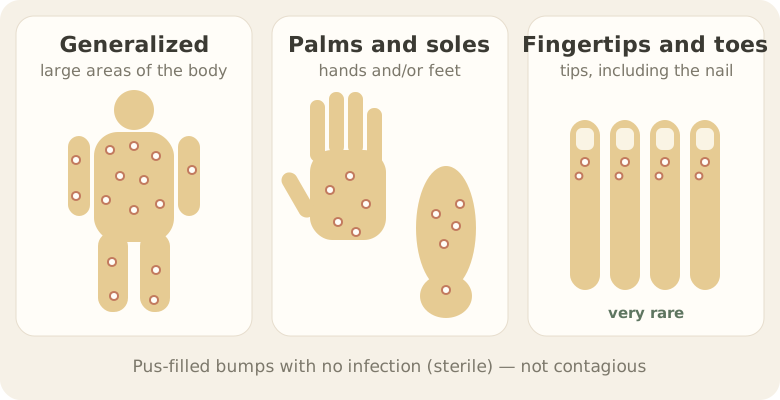
- Generalized pustular psoriasis (GPP) affects large areas of the body.
- Palmoplantar pustular psoriasis affects the palms of the hands and/or the soles of the feet.
- Acrodermatitis continua of Hallopeau affects the tips of the fingers and/or toes, including the nail. The NPF says it is very rare.
NIAMS says pustular psoriasis usually affects the hands and feet, but one form covers most of the body. The American Academy of Dermatology (AAD) says the localized form usually appears only on the hands and feet. It can make everyday tasks such as typing or walking very painful.
Generalized pustular psoriasis needs fast medical help
The AAD, which also calls it von Zumbusch psoriasis, describes the generalized form as serious and life-threatening and says medical care is often needed. The NPF says it can start suddenly and get worse quickly. Signs can include:
- fever and chills
- severe itching
- changes in heart rate
- tiredness
- muscle weakness
The NPF says to see a health care provider immediately if you think you have it.
The NHS (in the UK) advises calling 999 or going to A&E (the emergency department) if you have psoriasis and:
- your skin quickly turns red and you develop white, pus-filled bumps that join together
- patches on your feet turn yellow-brown and fill with pus
- your fingers or toes develop red, scaly, pus-filled bumps on the tips
It adds that these can be signs of a more serious condition or an infection, and that a fast heartbeat, high temperature, or feeling hot, cold or shivery are also warning signs. The NHS says not to drive yourself.
What can set it off
The sources we use list triggers rather than one single cause. The NPF lists:
- certain medicines, such as some antimicrobials and systemic steroids
- starting or stopping a medicine
- too much ultraviolet (UV) light
- infections with strep or staph germs
- pregnancy
- stress
NIAMS also names medicines, infections, stress and certain chemicals. A trigger isn't your fault. Never stop or change a medicine because you suspect it: talk to your doctor first.
How it is treated
The NPF says there is no cure, but treatment can improve symptoms. It lists three groups:
- topical treatments: creams and ointments applied to the skin
- phototherapy: controlled light treatment
- systemic treatments: tablets or injections that work throughout the body, including biologic medicines, which your doctor can explain
Choosing between them is a decision for your doctor. Talk to your doctor before starting, stopping or changing any treatment.
How to track pustular psoriasis in a diary
Notes help your doctor see what is happening between visits, especially if it flares quickly. You might record:
- where the bumps are: palms, soles, fingertips, or other areas
- how it looks: how many bumps, red or darker skin around them, cracking or peeling
- pain and itch, each on a scale of 0 to 10
- how it affects your day: walking, typing, gripping, sleep
- how you feel overall: any fever, chills or tiredness
- possible triggers: a new medicine, an infection, a stressful week, sun exposure
- a photo of the area every few days, in the same light, kept private
Example entry: Thursday. New bumps on both soles, right foot worse. Pain 6/10, itch 3/10. Hard to walk to the bus. No fever. Started a new medicine from another doctor last week. Will tell my dermatologist.
If you notice fever or fast-spreading redness, don't wait to log it. Seek help first and write it down afterwards. A diary app such as Velvi can keep these notes in one place for your appointment.
Questions to ask your dermatologist
- Which form of pustular psoriasis do I have?
- Could an infection or another rash look like this?
- Could any of my medicines be involved?
- What should I do, and who should I call, if it suddenly gets worse?
- Which treatments suit my form and where it is on my body?
- Should I be checked for other types of psoriasis or for joint problems?
When to see a doctor
See a GP (family doctor) or dermatologist if you have pus-filled bumps on your skin that keep coming back, are painful, or stop you from walking or using your hands.
See a doctor promptly if you have joint pain, stiffness or swelling that keeps coming back — it could be psoriatic arthritis.
Seek medical care now if you have widespread red skin, pus-filled bumps with a fever, or feel very unwell — contact your doctor or your local emergency number.
Frequently asked questions
Is pustular psoriasis contagious?
No. The NPF says the pus in the bumps is caused by inflammation, not infection, and is not contagious. The NHS says psoriasis can't be caught or spread.
Is the pus a sign of infection?
The NPF says the pustules are sterile, so germs don't cause them. But only a doctor can tell psoriasis from an infection, and the NHS says pus-filled bumps that spread quickly can be a sign of a more serious condition or an infection, so get urgent medical help rather than guessing.
Is pustular psoriasis the same as palmoplantar pustulosis?
The NPF calls the palms-and-soles form palmoplantar pustular psoriasis. None of our sources use the word "pustulosis", so ask your doctor whether and how the two terms differ for you.
Can pustular psoriasis go away?
The NPF says there is no cure, but treatment can improve symptoms. Ask your doctor what to expect for your form.
How common is it?
The NPF says about 3% of people with psoriasis have it.
Sources
- Pustular psoriasis — National Psoriasis Foundation
- Psoriasis: Signs and symptoms — American Academy of Dermatology
- Psoriasis — National Institute of Arthritis and Musculoskeletal and Skin Diseases (NIAMS)
- Psoriasis: symptoms — NHS
- Psoriasis — NHS
We check articles against these sources and update them when guidance changes. Read our editorial policy.