 Velvi
Short answer
Genital psoriasis is common. The National Psoriasis Foundation (NPF) says 33% to 63% of people with psoriasis have it. Patches look red or darker, smooth or scaly, and can itch, hurt or crack. Psoriasis is not contagious, but it can be mistaken for an infection, so see a doctor for a clear diagnosis.
A rash in the genital area can feel worrying, but it is a known part of psoriasis. This guide explains how it can look, how it can affect daily life and intimacy, what treatment options exist, and what to ask your doctor.
Where it appears
The NPF lists these areas:
- the crease between the thigh and the genitals
- the vulva, penis or scrotum
- the crease between the buttocks, including the skin around the anus
- the pubic area, above the genitals
- the inner and upper thigh
Psoriasis rarely affects only the genitals, the NPF says. Many people have it elsewhere too. It typically doesn't affect the skin inside the vagina, so symptoms there should be checked for other causes.
What it looks like
There are two common looks, and you can have either one. See Inverse psoriasis and Plaque psoriasis for more on each type.
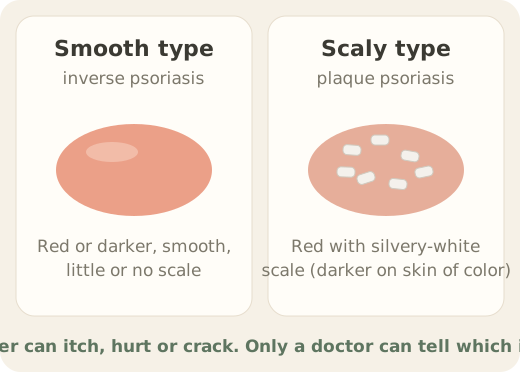
- Smooth patches (inverse psoriasis). The NPF describes red or discolored skin that looks smooth, sometimes tight, and has no scale. On skin of color it can look purple, brown or darker than the skin around it.
- Scaly patches (plaque psoriasis). On lighter skin, the NPF says plaques are red with a silvery-white build-up. On skin of color they can look darker, purple, gray or dark brown.
The NHS adds that on brown or black skin, psoriasis patches can leave dark marks after they clear.
How it can feel
The NPF says smooth patches can bring discomfort, pain, severe itching and skin splitting, and that sweat and rubbing can make them worse. Scaly patches can cause discomfort, pain, itching and cracking.
The NPF calls the genitals a "high-impact site": psoriasis there can affect quality of life even when only a small area is involved.
Intimacy and emotions
The NPF says sex can be painful or make symptoms worse. It also reports that people with genital psoriasis may have sex less often, have less desire and sometimes avoid intimate relationships. They may feel less comfortable with dating, intimacy and nudity.
None of this is a personal failing. If it affects you, say so to your doctor. It is a medical symptom, and doctors can help with it. If you have a partner, sharing this article may help them understand.
How doctors diagnose it
The NPF says a dermatologist (skin specialist) is the best person for an accurate diagnosis. NIAMS says a doctor may take a small skin sample to rule out other skin conditions, so ask whether you need one.
Is it contagious?
No. The NHS says psoriasis is not contagious: you can't catch it or pass it on. See Is psoriasis contagious?
Genital psoriasis can still look like other problems. The NPF says it is sometimes misdiagnosed as a sexually transmitted infection or a yeast infection. That's why a proper diagnosis matters. Only a doctor can tell what is causing a rash. Don't treat yourself for an infection you aren't sure you have.
Treatment: why the genital skin needs care
The NHS says psoriasis can't be cured, but treatments can help manage symptoms. NIAMS says the choice depends on the type, how severe it is, where it is and the possible side effects.
The NPF lists these groups of treatment for genital psoriasis:
- topical treatments: creams and ointments, some from a pharmacy and some prescribed, including steroid and non-steroid types
- phototherapy: controlled treatment with ultraviolet light
- systemic treatments: tablets or injections that work throughout the body
The NPF says systemic treatments aren't usually prescribed for genital psoriasis alone. A doctor may consider them if you also have psoriasis elsewhere or if creams haven't worked well enough.
Genital skin is thinner and reacts quickly to creams, the NPF says. Follow your provider's instructions and don't use more than recommended, to limit side effects.
As our own caution, don't use a cream you already have, or one meant for another part of your body, in the genital area unless a doctor has said it is safe. Talk to your doctor before starting, stopping or changing any treatment.
Everyday skin care
NIAMS's general advice for psoriasis is lukewarm water, mild soap with added oils, and a thick moisturizer applied while skin is still damp. Genital skin is delicate, so check with your doctor what suits this area.
The NPF notes that sweat and rubbing can make smooth patches worse. Some people notice flares after stress, infections, skin injury or certain medicines, according to the NHS and NIAMS. Don't stop a medicine because you suspect it. Ask your doctor first.
How to track genital psoriasis in a diary
A diary helps you describe changes to your doctor without having to remember. You might note:
- where the patches are and how far they reach
- how they look: smooth, scaly, cracked, red or darker
- itch and pain, each from 0 to 10
- what makes it worse: sweat, friction, stress, illness
- what you used on the area, as your doctor advised
- effect on your day: sleep, sitting, exercise, intimacy, mood
- psoriasis elsewhere, such as the scalp, nails or skin folds
- photos, if you wish, kept private and taken in the same light
Example entry: Monday. Red, smooth patch in the groin crease, itch 6/10, stings after exercise. Stressful week. Used only the cream my doctor prescribed. Skipped the gym because of rubbing.
An app such as Velvi can keep these notes and photos in one private place, ready for your appointment.
Questions to ask your doctor
- Is this psoriasis, or could it be an infection or another rash?
- Do I need a skin sample or any other tests?
- Which treatments are safe for this area, and how long should I use them?
- Should I see a dermatologist?
- What should I avoid using on the skin there?
- Is it safe to have sex, and what can I do if it hurts?
- Do I have psoriasis elsewhere that needs attention?
- When should I come back if it doesn't improve?
When to see a doctor
See a GP (family doctor) or dermatologist if you have a rash in the genital area that doesn't settle, if it is painful, cracking or very itchy, or if you aren't sure what it is. The NPF says a GP or OB-GYN is often the first contact, and recommends a dermatologist for an accurate diagnosis. Also see a doctor if a treatment isn't working or causes side effects, and about any symptoms inside the vagina.
See a doctor promptly if you have joint pain, stiffness or swelling that keeps coming back — it could be psoriatic arthritis.
Seek medical care now if you have widespread red skin, pus-filled bumps with a fever, or feel very unwell — contact your doctor or your local emergency number.
Frequently asked questions
Is genital psoriasis common?
Yes. The NPF says 33% to 63% of people with psoriasis have it, at any age.
Is genital psoriasis an STI?
No. Psoriasis is thought to be linked to the immune system and is not contagious, according to the NHS. It can be mistaken for an infection, so ask a doctor to look at it.
Can genital psoriasis happen without psoriasis elsewhere?
The NPF says psoriasis rarely affects only the genitals. If you have a rash only there, a doctor can work out the cause.
Does genital psoriasis go away?
The NHS says psoriasis can't be cured, but treatment can help manage symptoms. Symptoms can flare up and settle, so a diary can help you spot patterns.
Can I use any cream on the area?
Ask your doctor first. The NPF says genital skin is thin and responds quickly to creams, so use only what your provider advises.
Can I have sex with genital psoriasis?
The NHS says you can't catch or spread psoriasis, so a partner can't catch it from you. The NPF says sex can be painful or make symptoms worse. Talk to your doctor about what is right for you.
Sources
- Genital psoriasis — National Psoriasis Foundation
- Psoriasis: symptoms — NHS
- Psoriasis — NHS
- Psoriasis: diagnosis, treatment and steps to take — National Institute of Arthritis and Musculoskeletal and Skin Diseases (NIAMS)
We check articles against these sources and update them when guidance changes. Read our editorial policy.