 Velvi
Short answer
Erythrodermic psoriasis is a rare, severe type of psoriasis in which the skin turns red and scaly over most of the body. The National Psoriasis Foundation calls it a medical emergency, and the American Academy of Dermatology says it needs immediate medical care. If you have psoriasis and your skin is turning red all over, get urgent help rather than waiting for an appointment.
If this is happening now: seek medical care straight away and bring your medicines. In the UK, don't drive yourself.
This page is for people who have psoriasis, or care for someone who does, and want to know what this type looks like and what to do. It is rare, so most people with psoriasis will never have it. Knowing the warning signs still matters, because it needs urgent medical care.
The National Psoriasis Foundation (NPF) says about 2 in every 100 people with psoriasis have it. For the other types, see Types of psoriasis.
What erythrodermic psoriasis looks like
"Erythrodermic" means red skin. In this type, redness covers most of the body. The NPF says it can look purple or brown on darker skin, so don't rely on how red the skin looks alone. The NHS also says redness may be harder to see on brown or black skin.
The NPF and the American Academy of Dermatology (AAD) describe other signs:
- skin that looks burned
- scaling or shedding, often in large sheets (NPF)
- swelling and strong itching
- hair loss and nail changes (NPF)
- fever and chills
- tiredness (NPF) and muscle weakness (AAD)
- a fast pulse
The AAD adds that the person can look very ill. The NPF says body temperature can swing up and down, and the AAD says the person may be unable to keep warm, so their temperature can drop quickly.
It looks very different from the raised, dry patches of plaque psoriasis. Only a doctor can tell what is causing red skin. The NPF says doctors look at how the skin looks, how much of the body is covered and how itchy it is.
Why it is an emergency
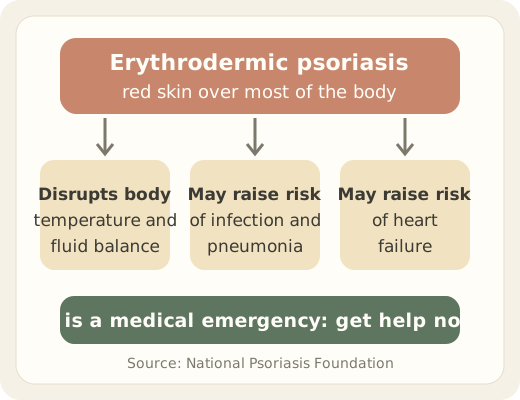
The NPF says this type can be life-threatening. It disrupts body temperature and fluid balance (the body's water balance). People with it may also have a higher risk of infection, pneumonia and heart failure.
Who gets it and what can set it off
The AAD says most people who develop it already have another type of psoriasis. NIAMS says it often develops in people whose other type of psoriasis is not well controlled. If your psoriasis is getting worse or not responding to treatment, the AAD advises seeing a skin specialist (dermatologist). If it is spreading over most of your body or you feel very unwell, treat it as an emergency, not a routine visit.
The NPF lists possible triggers:
- an allergic reaction to a medicine
- certain medicines, such as steroid tablets or injections (systemic steroids)
- starting or stopping a medicine
- infections or severe illness
- severe sunburn
- stress
- alcohol use
NIAMS also names a bad sunburn and certain medicines such as corticosteroids. Triggers are not your fault. Never stop or change a medicine because you suspect it. Talk to your doctor first.
What happens in treatment
The NPF says the first goal is to bring body temperature and fluid balance back to normal, and that a hospital stay may be needed depending on how severe it is. Once the worst has passed, longer-term options can include creams and ointments, light therapy, or tablets and injections that work throughout the body. Your doctor chooses among them.
The NPF says psoriatic disease is lifelong, but symptoms can clear and come back.
How to keep a diary so you can spot trouble early
A diary can't replace medical care. It can help you notice a change sooner and give your doctor a clear picture afterwards. You might note:
- how much of your body has red or sore skin, using a simple "none / a few areas / most of me" scale
- itch and pain, each from 0 to 10
- temperature and how you feel: chills, shivering, fever, weakness
- possible triggers: a new medicine, a missed treatment, a sunburn, an infection, a stressful week
- medicines you take, including any started by another doctor
Example entry: Tuesday. Red patches spreading from my back to chest and legs, most of my body now. Very itchy, 8/10. Feeling shivery. Calling my doctor now.
If the skin is turning red all over, don't stop to write it down. Get help first and add the notes later. A diary app such as Velvi can keep these notes in one place for your appointment.
Questions to ask your dermatologist
- Am I at risk of this type, given my psoriasis and treatment?
- Which signs should make me go to the emergency department?
- Who should I call, and what should I bring, if my skin suddenly turns red?
- Could any of my medicines or habits be a trigger?
- Is my current treatment controlling my psoriasis well enough?
When to see a doctor
See a doctor or dermatologist if your psoriasis is getting worse or is not responding to treatment.
See a doctor promptly if you have joint pain, stiffness or swelling that keeps coming back — it could be psoriatic arthritis.
Seek medical care now if you have widespread red skin, pus-filled bumps with a fever, or feel very unwell — contact your doctor or your local emergency number. In the UK, the NHS says to call 999 or go to A&E if your skin quickly turns red and you get pus-filled bumps that join together, or if you have a fast heartbeat or feel hot, cold or shivery. Don't drive yourself, and bring your medicines.
Frequently asked questions
Is erythrodermic psoriasis an emergency?
Yes. The NPF calls it a medical emergency and the AAD says it needs immediate medical care.
How common is erythrodermic psoriasis?
It is rare. The NPF says about 2% of people with psoriasis have it.
Is erythrodermic psoriasis contagious?
No. The NHS says psoriasis can't be caught or spread. See Is psoriasis contagious?
What is the difference between erythrodermic and pustular psoriasis?
Erythrodermic psoriasis is redness over most of the body. Pustular psoriasis causes pus-filled bumps on the skin. Both can be serious, and only a doctor can tell which you have.
Can erythrodermic psoriasis be cured?
No. The NPF says there is currently no cure for psoriatic disease, and that symptoms can clear and come back. Treatment can help, so ask your doctor what to expect.
Sources
- Erythrodermic psoriasis — National Psoriasis Foundation
- Psoriasis: Signs and symptoms — American Academy of Dermatology
- Psoriasis — National Institute of Arthritis and Musculoskeletal and Skin Diseases (NIAMS)
- Psoriasis: symptoms — NHS
We check articles against these sources and update them when guidance changes. Read our editorial policy.