 Velvi
Short answer
Psoriatic arthritis is a type of arthritis linked to psoriasis. Common symptoms are pain, swelling and stiffness in one or more joints, often worse in the morning. Swollen fingers or toes, nail changes and tiredness can go with it. If joint symptoms keep coming back, see a doctor soon: early treatment may help prevent lasting joint damage.
This article is for people with psoriasis who have started to notice aching joints, and for anyone with joint symptoms who wonders where they come from. It lists the signs, explains how they can differ from person to person, and shows what to bring to a doctor. It cannot tell you whether you have it. Only a doctor can.
The main symptoms
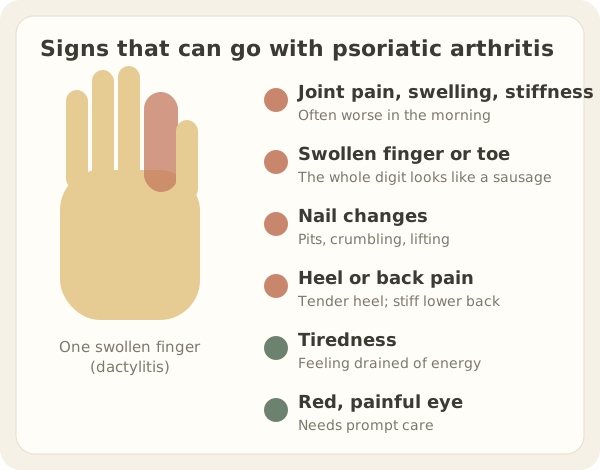
Symptoms vary a lot between people, says the National Institute of Arthritis and Musculoskeletal and Skin Diseases (NIAMS). MedlinePlus adds that the condition is often mild but can sometimes be serious and affect many joints. These are the signs the NHS, NIAMS and the National Psoriasis Foundation (NPF) describe:
- Joint pain, swelling and stiffness in one or more joints.
- Morning stiffness. The NHS says joint symptoms can be worse in the morning and may improve with exercise. The NPF describes joint pain that is worse in the morning or after inactivity.
- Swollen fingers or toes. When a whole finger or toe swells up like a sausage, doctors call this dactylitis.
- Tender spots where tendons attach to bone. NIAMS calls this enthesitis and names the back of the heel and the sole of the foot as common places. The NPF also lists pain in the feet and ankles.
- Back, neck or hip stiffness. NIAMS says the joints of the spine can be affected, leading to stiffness in the neck, lower back and hips. The NPF lists lower back pain above the tailbone.
- Warm or discolored joints. The NPF says joints may look red or discolored, or feel warm.
- Nail changes, such as tiny dents (pits), crumbling, color change or a nail lifting from the nail bed.
- Tiredness. The NHS and NIAMS both list feeling drained of energy.
- Eye inflammation. NIAMS says inflammation inside the eye (uveitis) can cause eye pain, redness and blurry vision, and needs prompt treatment to avoid vision loss.
Some people also have patches of psoriasis on the skin at the same time, says the NHS.
Do the skin and joint symptoms start together?
Not always. MedlinePlus says joint and skin problems do not always start at the same time. NIAMS says most people with psoriatic arthritis already have psoriasis when they are diagnosed, and that on average the arthritis develops about 7 to 10 years after the skin symptoms begin. A small group get joint pain before any skin changes.
The NPF says roughly 1 in 3 people with psoriasis also have psoriatic arthritis, and that more than 15% of people with psoriasis may have it without knowing. The NHS says psoriatic arthritis happens when the immune system attacks healthy tissue, as in psoriasis, but it is not clear why some people with psoriasis get it and others do not. NIAMS says obesity and severe psoriasis appear to be linked to a higher risk.
If your skin has changed, see Psoriasis symptoms for the skin side.
Nail changes can be part of it
Nail changes are on the NHS, NIAMS and NPF lists of symptoms. If you have pits or a lifting nail and also sore joints, mention both. Our article on nail psoriasis shows what these changes can look like. Hands and feet are common places for symptoms, so psoriasis on hands and psoriasis on feet may also help.
Could it be something else?
Yes. The NHS says osteoarthritis, rheumatoid arthritis and gout can cause similar symptoms. The NPF says there is no single test for psoriatic arthritis, so doctors rely on an examination and your history, and getting a clear answer can take a few appointments with a rheumatologist. MedlinePlus says a doctor uses a physical exam and imaging tests. The NHS says a GP who suspects it will refer you to a joint specialist (a rheumatologist). Blood tests, X-rays, ultrasound or MRI scans may be used.
That is why a vague "my joints hurt" is worth a visit rather than a guess.
Why seeing a doctor early matters
The NPF says early diagnosis and treatment may help prevent permanent joint damage. NIAMS says early treatment is linked to better outcomes and less damage. There is no cure, but NIAMS says treatments can slow the disease, ease pain and protect joints. Which treatment is right is a decision for your doctor. Do not change or stop any medicine on your own.
How to track joint symptoms in a diary
A doctor cannot see your morning stiffness, so a few weeks of notes help. You might write down:
- which joints hurt or swell (left or right, fingers, toes, heel, back)
- morning stiffness: how many minutes until it eases
- swelling: a whole finger or toe, or one joint
- pain, from 0 to 10, and what you were doing
- tiredness, from 0 to 10
- nails and skin changes at the same time
- eyes: any redness or pain
Example entry: Oct 28. Stiff in both hands when I woke up, about 45 minutes before it eased. Right index finger looks swollen all the way along. Heel sore on the first steps. Tiredness 6 out of 10. Two new pits on the right thumbnail (example only).
An app such as Velvi can keep these notes in one place to show your doctor. It tracks symptoms; it does not diagnose.
Questions to ask your doctor
- Could my joint symptoms be related to my psoriasis, or is something else more likely?
- Do I need to see a rheumatologist?
- Which tests might you suggest, and what would they tell us?
- Should my nail changes or tiredness be part of this conversation?
- What changes should I watch for, and when should I call you?
When to see a doctor
See a GP (family doctor), or the doctor who treats your psoriasis, soon if you have joint pain, stiffness or swelling that keeps coming back. The NHS advises seeing a GP for this even if you do not have psoriasis.
See a doctor promptly if you have a painful, red eye or blurry vision. NIAMS says eye inflammation must be treated promptly to avoid vision loss.
Seek medical care now if you have widespread red skin, pus-filled bumps with a fever, or feel very unwell — contact your doctor or your local emergency number.
Frequently asked questions
What are the first signs of psoriatic arthritis?
The sources do not say which sign comes first, and it differs between people. The NHS, NIAMS and NPF describe joint pain, swelling or stiffness, swollen fingers or toes and nail changes. The NHS and NIAMS also list tiredness. A doctor can tell what is causing them.
Can you have psoriatic arthritis without a rash?
Yes. NIAMS says a small group of people get joint pain before any skin changes. See a doctor for joint symptoms even if your skin is clear.
Is psoriatic arthritis the same as rheumatoid arthritis?
They are different conditions that can cause similar symptoms. The NHS lists rheumatoid arthritis, osteoarthritis and gout as conditions with similar symptoms. Only a doctor can tell them apart.
Does psoriatic arthritis cause tiredness?
It can. The NHS and NIAMS list fatigue among the symptoms. Tell your doctor if you feel drained, as there can be other reasons too.
Can psoriatic arthritis be treated?
There is no cure, says NIAMS, but treatments can slow it, ease pain and protect joints. According to the NHS, medicines are the main treatment, and a physiotherapist can teach exercises to protect joints. Your doctor decides what suits you.
Sources
- Psoriatic arthritis — NHS
- Psoriatic arthritis — National Institute of Arthritis and Musculoskeletal and Skin Diseases (NIAMS, NIH)
- About psoriatic arthritis — National Psoriasis Foundation
- Psoriatic arthritis — MedlinePlus (NIH)
We check articles against these sources and update them when guidance changes. Read our editorial policy.