 Velvi
Short answer
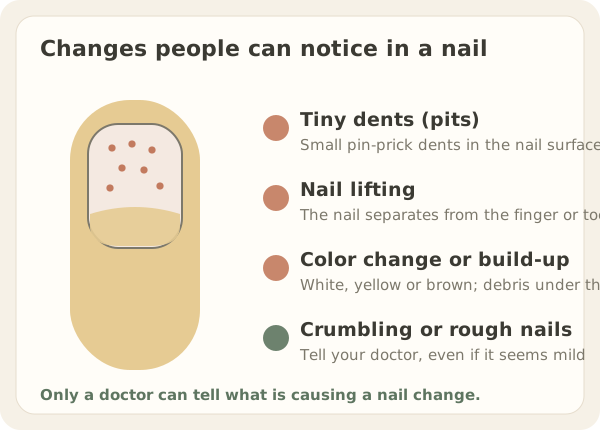
Nail psoriasis is psoriasis that affects the fingernails or toenails. Common signs are tiny dents (pits), a nail that lifts away from the finger or toe, color changes and crumbling. Other conditions, such as a fungal infection, can look similar, so a doctor needs to confirm the cause. Treatments can help, but nails grow slowly, so it takes time.
What nail psoriasis can look like
The American Academy of Dermatology (AAD) lists these common signs:
- tiny dents in the nail, called nail pits
- white, yellow or brown discoloration
- crumbling nails
- a nail separating from the finger or toe
- buildup beneath the nail
- blood under the nail (see a doctor rather than assuming it is an injury or psoriasis)
MedlinePlus also lists thickened nails. Nail psoriasis can be mild, according to the AAD, so a small change is still worth noting. This list is not a self-diagnosis checklist: other things can change nails too. We do not give a figure for how common it is, because the sources we checked do not state one.
For the rest of the skin, see Psoriasis symptoms, Psoriasis on hands and Psoriasis on feet.
Can it happen without skin psoriasis?
Most often it shows up years after skin psoriasis begins, says the AAD. But it can also appear without any skin signs. If you have nail changes and no rash, you can still ask a doctor about it.
Nail psoriasis or fungal infection?
Some changes of a fungal nail infection are also seen in nail psoriasis. The NHS says a fungal infection usually affects toenails, though it can affect fingernails. It often starts at the edge of the nail, and the nail can turn thick, white or yellow, brittle and crumbly. Sometimes it lifts off.
So both can leave a nail thick, discolored and crumbly. Because the changes can overlap, a doctor may test a nail sample. The AAD says dermatologists also look for infection and may clip a piece of nail or scrape debris from underneath it to test in a lab. The NHS says a GP may also send a nail sample for testing before prescribing antifungal tablets.
Only a doctor can tell which one it is. Psoriasis and infection are treated differently, which is why the answer matters. For a similar comparison on skin, see Psoriasis vs eczema.
Nails and psoriatic arthritis
The AAD says nail changes can also be a sign of psoriatic arthritis, a type of arthritis linked to psoriasis. The National Psoriasis Foundation (NPF) lists pitting or separation from the nail bed among the signs of psoriatic arthritis. It says about 1 in 3 people with psoriasis also have it, and the skin symptoms usually come first.
The NPF says early diagnosis and treatment can relieve symptoms and may help prevent permanent joint damage. So if you have nail changes and also joint pain, stiffness or swelling, tell your doctor soon. The NHS says to see a GP if joint pain, stiffness or swelling keeps coming back.
Is it contagious?
No. The NHS says psoriasis is not contagious. A fungal nail infection can spread, so it is another reason to have a changed nail checked.
Treatment options, at a high level
The AAD describes a sequence of options. Your doctor chooses what suits you, and you should not start, stop or change anything on your own.
- Applied to the nail. For mild or early nail psoriasis, or when few nails are affected, a dermatologist may suggest creams or ointments. The AAD names a strong steroid, a vitamin D-type and a vitamin A-type medicine, and says two are sometimes combined.
- Injections. If creams do not work or are hard to apply, the AAD says a dermatologist may inject medicine near the affected nails.
- Medicines for the whole body. For severe psoriasis or severe nail psoriasis, medicines that treat the whole body, such as tablets or injections, may be an option. The AAD says these can take months to show results.
Nails grow slowly. The AAD says treatment applied to the nail typically takes at least six months, so it can take that long to judge whether it is working. Some people need to try more than one treatment. Use treatment as directed, for as long as directed, and talk to your doctor before changing anything.
How to track your nails in a diary
Changes in nails are slow, so a diary helps you and your doctor see the trend. You might note:
- which nails are affected (fingers or toes, left or right)
- what you see: pits, lifting, color change, buildup, crumbling
- pain or tenderness, from 0 to 10
- nearby joints: stiffness or swelling in the finger or toe, and for how long
- what you used on the nails, as your doctor advised
- photos, if you wish, in the same light every few weeks
Example entry: Oct 28. Right ring and middle fingernails: about 10 small pits each, the ring nail has a yellow patch at the tip that looks slightly lifted. No pain. Left big toenail thicker than last month. Last joint of right ring finger a bit stiff this morning, about 20 minutes (example only).
An app such as Velvi can keep these notes and photos in one private place for your appointment.
Questions to ask your dermatologist
- Is this nail psoriasis, a fungal infection or something else? Do you need to test a nail sample?
- Which treatment suits my nails, and how long should I use it before we judge if it works?
- Do my nail changes mean I should be checked for psoriatic arthritis?
- What can I do at home to look after my nails?
- When should I come back if the nails do not improve?
When to see a doctor
See a GP (family doctor) or dermatologist if you notice any of the nail changes above, if treatment isn't working or you have trouble applying it, or if a treatment causes side effects.
See a doctor promptly if you have joint pain, stiffness or swelling that keeps coming back — it could be psoriatic arthritis.
See a doctor or pharmacist if a nail is painful or the skin around it is swollen. The NHS also advises a GP visit for a fungal nail infection if you have diabetes or a weakened immune system.
Seek medical care now if you have widespread red skin, pus-filled bumps with a fever, or feel very unwell — contact your doctor or your local emergency number.
The NHS also says to get urgent help (999 or A&E in the UK) if the tips of your fingers or toes have red, scaly, pus-filled bumps, especially with a fast heartbeat, a high temperature, or feeling hot, cold or shivery.
Frequently asked questions
What does nail psoriasis look like?
According to the AAD, common signs are tiny dents (pits), white, yellow or brown discoloration, crumbling, a nail separating from the finger or toe, and buildup under the nail.
Is nail psoriasis the same as a fungal infection?
No. They can look alike, and a fungal infection can also cause thick, discolored, crumbly nails, says the NHS. Doctors may test a nail sample, and only a doctor can tell which one it is.
Can I have nail psoriasis without skin psoriasis?
Yes. The AAD says nail psoriasis usually appears years after skin psoriasis but can occur without skin signs.
Are nail changes a sign of psoriatic arthritis?
They can be. The AAD says nail changes can signal psoriatic arthritis, and the NPF lists pitting and separation among its signs. Tell your doctor, especially if you also have joint pain or swelling.
Can nail psoriasis be treated?
Treatments can help manage it. The AAD describes creams, injections near the nail and medicines for the whole body. Treatment takes months because nails grow slowly, so ask your dermatologist what to expect.
Sources
- Nail psoriasis: what is it and how can I treat it? — American Academy of Dermatology (AAD)
- Psoriasis: symptoms — NHS
- Fungal nail infection — NHS
- About psoriatic arthritis — National Psoriasis Foundation
- Psoriasis — MedlinePlus (NIH)
We check articles against these sources and update them when guidance changes. Read our editorial policy.